

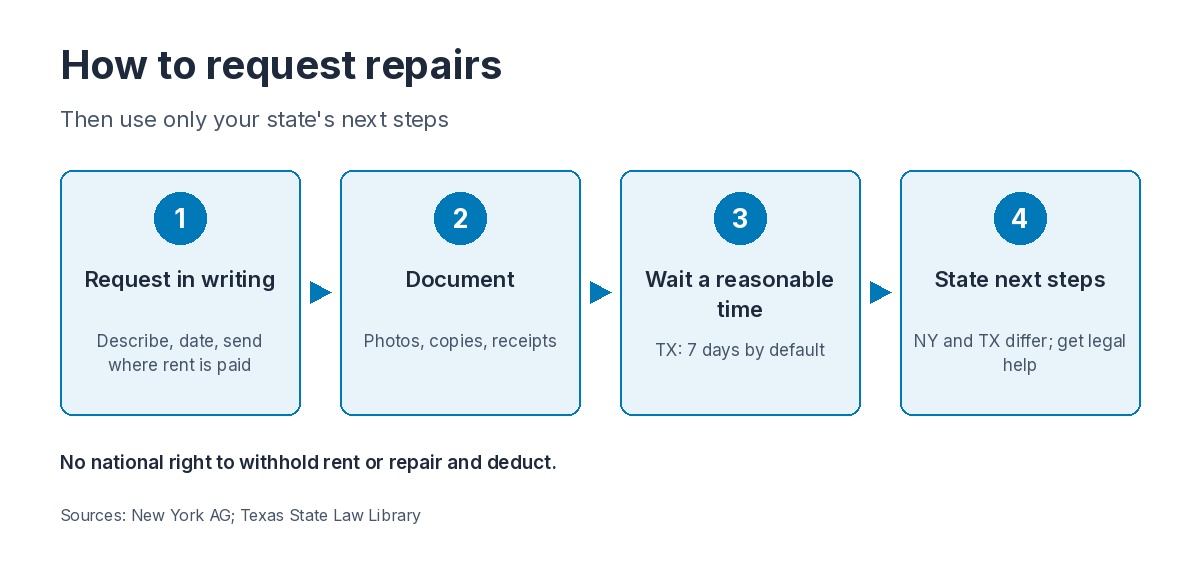
To request repairs from your landlord, put the request in writing even if your state allows oral notice. Describe each problem, date the request, send it where you normally pay rent or as your lease says, and keep copies and photos. Then give the landlord a reasonable time and use only the next steps your state allows.
General information, not legal advice. Habitability duties and repair remedies vary by state and your facts. Get help from a local tenant attorney or legal-aid office before you withhold rent, hire a contractor, or move out.
Does your landlord have to make repairs?
Usually yes for serious problems, but the legal standard depends on your state. New York and Texas, the two examples here, use different frameworks.
New York (state-specific): The New York Attorney General’s tenant guidance says tenants have the right to a livable, safe and sanitary apartment, that this right is implied in every written or oral residential lease, and that any lease clause waiving it is void. The AG gives examples of violations, such as not providing heat or hot water on a regular basis or not getting rid of an insect infestation, and says the warranty covers public areas too (Real Property Law 235-b).
The New York AG also says that if a tenant or someone under the tenant’s control causes the problem, it is not a breach, and that all repairs must be made within a reasonable time that may vary with the severity of the repair.
Texas (state-specific): The Texas State Law Library’s Requesting Repairs guide says a landlord must make a diligent effort to repair a problem that “materially affects the physical health or safety of an ordinary tenant.” Under section 92.052, the library says the tenant must be current on rent, must have notified the person or place where rent is normally paid, and the problem must not have been caused by the tenant or their guests, unless it resulted from normal wear and tear. A lease may give the landlord more repair duties than the law requires.
How do you request repairs from your landlord in writing?
Send a dated written request describing each problem to the person or place your lease names, and keep proof of when you sent it.
In Texas, the Texas State Law Library’s Requesting Repairs guide says the first notice goes to the person or place where rent is normally paid and does not have to be written unless a written lease requires it. If the problem is not fixed in a reasonable time, which subsection (d) of section 92.056 sets at 7 days though that can be challenged, the tenant sends a second notice in writing. The library says sending the first notice by certified mail, return receipt requested, registered mail, or another tracked mail or delivery service means a second notice is not required.
In New York, the New York Attorney General’s tenant guidance says rent-regulated tenants must communicate in writing with the landlord about the problem before filing a rent-reduction complaint with the Division of Housing and Community Renewal (DHCR).
What to put in the request (suggestions):
- What is broken or unsafe, and where in the unit.
- When you first noticed it.
- How it affects health, safety or services the lease promises.
- When someone can enter to fix it.
- How the landlord should confirm the appointment.
What should you document when you ask for a repair?
Keep copies of every message, dated photos or video of the problem, and receipts for any costs.
The New York Attorney General’s tenant guidance advises tenants to keep receipts for repairs and copies of all communications with the landlord. Photos and a simple log of dates are practical additions. If the landlord needs to come in, see our guide on whether a landlord can enter without notice.
What can you do if the landlord does not make the repair?
Only what your state allows. There is no national right to withhold rent or to repair and deduct, and the New York and Texas options below are state-specific.
New York: The New York Attorney General’s tenant guidance says a tenant can sue for a rent reduction if the landlord breaches the warranty. Rent-regulated tenants can file a DHCR rent-reduction complaint at least 10 days and no more than 60 days after sending notice to the landlord. The AG says a tenant may withhold rent, but the landlord may sue for nonpayment and the tenant may countersue. In extenuating circumstances, the AG says tenants may make necessary repairs and deduct reasonable costs, giving the example of a broken door lock the landlord willfully neglects after notice.
Texas: The Texas State Law Library’s Remedies for Failure to Repair guide says simply withholding some or all of the rent is not an option under the law and can make the tenant liable for one month’s rent plus $500 and attorney’s fees under section 92.058. After the required notice steps, the library says a tenant may be able to ask a court to order repairs, repair and deduct, or end the lease, though not all repairs qualify.
The Texas guide describes strict limits on repair-and-deduct under section 92.0561: eligible conditions include raw sewage backup, flooding from broken pipes, broken heating or cooling equipment, lack of potable water, or a condition a local official confirms affects health and safety. The deduction cannot exceed one month’s rent or $500, whichever is greater, and repairs must be made by an independent licensed contractor, not the tenant or their family, unless both sides agree otherwise.
In a Texas repair lawsuit under section 92.0563, the library says a court can order repairs, reduce rent, and award one month’s rent plus $500, actual damages, costs and attorney’s fees, with the total judgment capped at $20,000 excluding interest and court costs. If you are thinking about moving out instead, read how to break a lease and get legal help first.
| After a reasonable time | New York (AG) | Texas (State Law Library) |
|---|---|---|
| Withhold rent | Possible, but landlord may sue for nonpayment | Simply withholding is not an option |
| Repair and deduct | Only in extenuating circumstances, keep receipts | Strict 92.0561 limits, licensed contractor |
| Go to court or agency | Sue for rent reduction; DHCR (rent-regulated) | Court order, rent reduction, penalties |
Can a landlord retaliate because you asked for repairs?
Texas law, for example, bars retaliation for repair requests and lets tenants recover a penalty. Check your own state’s rules.
The Texas State Law Library’s Requesting Repairs guide says section 92.331 bars a landlord from retaliating because a tenant gives a notice to repair or complains in good faith to a government agency about a code violation. Prohibited retaliation can include filing an eviction in covered circumstances, cutting services, raising rent or ending the lease. Under section 92.333, the library says a tenant may recover one month’s rent plus $500, actual damages, court costs and attorney’s fees, minus any rent owed.
Is a disability-related change the same as a repair request?
No. A change to a rule or to the unit because of a disability is a reasonable accommodation or modification request, which follows fair housing rules rather than repair law.
How does Apartment One fit in for renters?
Apartment One lets you screen once and share one report, and its in-app messaging helps keep landlord and renter communication in writing. Read your lease’s repair terms before you sign; see our lease agreement checklist and how to rent your first apartment.
Apartment One is an online platform where renters complete a verified background and credit screening once, then get matched to rental properties they qualify for, while landlords list properties for free and receive pre-screened applicants.
Screening covers credit (FICO 9 from Experian), eviction and criminal records. Quick Screen is $35 one-time for a screening report only, and Tenant Plus is $60 one-time for screening plus access to matched property listings. Pricing can vary by state.
The Tenant Fit Index (TFI) is Apartment One’s 0-100 score matching a renter to a property based on credit, income-to-rent ratio, eviction history, criminal history, and lifestyle preferences. The TFI is a tool used alongside written criteria, not a ranking or a decision-maker.
Apartment One is FCRA-compliant and follows GLBA and CCPA data handling. Data is encrypted, and payments are processed through Stripe.
Screen once, then apply with a shareable report.
Frequently asked questions
Do I have to put the repair request in writing?
In Texas, the first notice does not have to be written unless the lease says so, but a second notice must be written, and certified or tracked mail can replace it. New York’s DHCR path requires prior written communication.
Can I just stop paying rent?
There is no national yes. Texas says simply withholding rent is not an option and can create liability. New York says a tenant may withhold, but the landlord may sue for nonpayment.
What is repair-and-deduct?
A state-specific remedy with strict limits. Texas section 92.0561 limits eligible conditions and amounts, and New York’s AG describes it only for extenuating circumstances, such as a broken lock the landlord neglects.
Is a disability-related change the same as a repair request?
No. That is a reasonable accommodation or modification request under fair housing rules.
Is this legal advice?
No. Talk to a local tenant attorney or legal-aid office before you withhold rent, hire a contractor, or move out.
One Response