

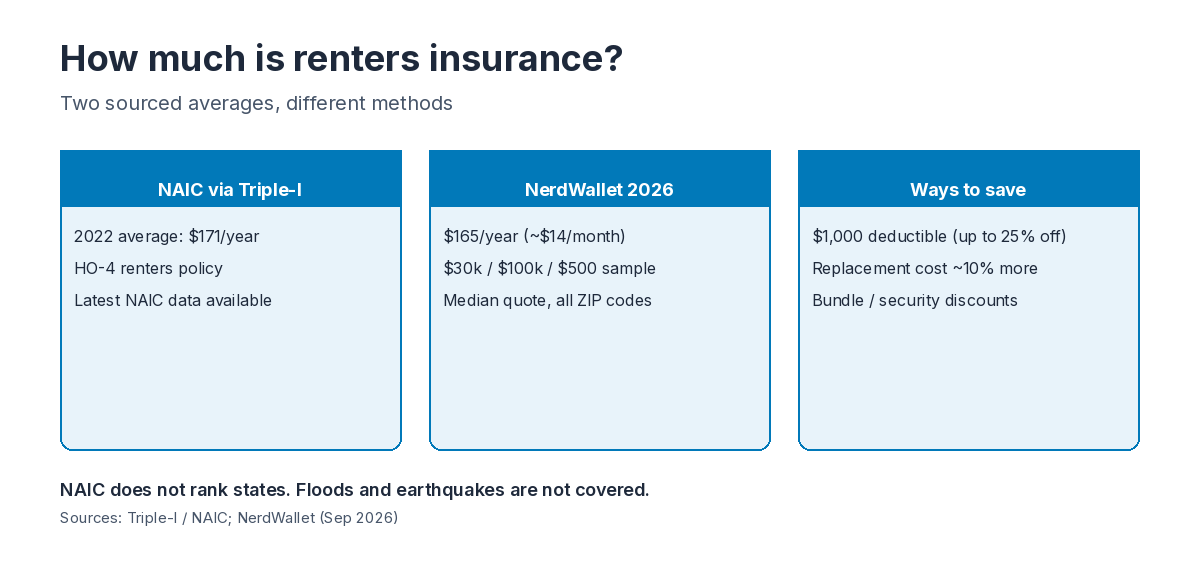
Most renters pay in the low hundreds of dollars a year for renters insurance, but your quote depends on your state, coverage amount, deductible and discounts. Two published figures put a typical policy near $14 to $15 a month: NAIC’s 2022 U.S. average of $171 a year, and NerdWallet’s 2026 quote analysis, which puts the median at $165 a year for a $30,000/$100,000/$500 policy.
General information, not insurance advice. Premiums, coverage, exclusions, and discounts vary by insurer, state, and policy. Read your policy and compare quotes from licensed insurers.
How much does renters insurance cost per month?
There is no single official 2026 national rate. Two published figures put typical annual premiums near the mid-$160s, or about $14 a month.
Triple-I (Insurance Information Institute), citing the National Association of Insurance Commissioners (NAIC), says the average renters insurance premium rose by 0.6 percent in 2022, ending seven consecutive annual declines, according to a May 2025 NAIC study described as the latest data available. The NAIC table shows the U.S. average renters premium was $171 in 2022 for an HO-4 renters policy with broad named-peril coverage for tenants’ personal property.
NerdWallet’s 2026 rate analysis (updated September 23, 2026) puts the median U.S. renters insurance cost at $165 per year, or about $14 per month, for a policy with $30,000 in personal property coverage, $100,000 in liability coverage and a $500 deductible. NerdWallet says it calculated the median rate from multiple insurers in every ZIP code across all 50 states and D.C., rounded to the nearest $5.
| Source | Year | Average | What it measures |
|---|---|---|---|
| NAIC via Triple-I | 2022 | $171/year | HO-4 average premium (premiums divided by exposure per house-year) |
| NerdWallet rate analysis | 2026 | $165/year (~$14/month) | Median quote for $30k personal property / $100k liability / $500 deductible |
Why is renters insurance more expensive in some states?
State and location drive price. NAIC’s 2022 table (via Triple-I) and NerdWallet’s 2026 quotes both show wide state differences.
From the Triple-I NAIC 2022 table: New Mexico $177, Texas $199, California $169, New York $169; Mississippi was the highest at $262 and North Dakota the lowest at $123. Triple-I notes that average premium equals premiums divided by exposure per house-year, and that NAIC does not rank states or endorse conclusions drawn from the data.
NerdWallet’s 2026 analysis puts New Mexico at $145 per year, or $12 per month, for the same $30k/$100k/$500 sample policy. Those methods differ from the NAIC average, so treat them as separate estimates.
Because averages hide a lot of variation within a state, get quotes for your ZIP code and for the coverage amounts you actually need rather than relying on a national figure alone.
What does a standard renters policy cover?
A standard policy usually covers your personal property and liability for injury or damage you cause, with separate limits for valuables and off-premises items. It does not cover floods or earthquakes.
According to Triple-I’s Renters Insurance page, a standard renters policy includes liability protection for bodily injury or property damage you or family members cause to others (and damage your pets cause). Liability limits generally start at about $100,000, and some experts recommend at least $300,000. No-fault medical coverage is generally $1,000 to $5,000.
Triple-I says off-premises coverage typically applies with limits (its example: $25,000 of possessions coverage may cover up to $2,500, or 10 percent, away from home). Valuables are generally covered up to $1,500 for jewelry or other expensive items unless you add a floater or endorsement. Renters insurance does not cover floods or earthquakes; flood coverage is available from the National Flood Insurance Program and some private insurers, and earthquake coverage can be a separate policy or an endorsement. Check your policy for other exclusions, such as mold or pest damage, rather than assuming they are covered.
How do your deductible and coverage type change the price?
Replacement-cost coverage costs more than actual cash value, and a higher deductible can lower the premium, though you pay more out of pocket on a claim.
Triple-I says actual cash value pays to replace possessions minus depreciation, while replacement cost pays the actual cost with no depreciation deduction, and replacement-cost coverage costs about 10 percent more than actual cash value.
To save, Triple-I suggests considering a deductible of at least $500, and says raising it to $1,000 may get as much as 25 percent off the premium, but you pay the deductible on each claim.
How can you lower your renters insurance premium?
Ask about bundling and safety discounts, pick a deductible you can afford, and compare quotes from more than one insurer.
Triple-I says insurers often discount for bundling with car or business policies, and for security systems, smoke detectors or deadbolt locks.
A practical checklist (suggestions):
- Inventory your belongings so you pick a coverage amount that fits.
- Compare actual cash value vs. replacement cost.
- Choose a deductible you could pay tomorrow.
- Ask about bundling and security discounts.
- Confirm whether your lease requires a minimum liability limit or listing the landlord as an interested party.
For whether a landlord can require a policy, see can a landlord require renters insurance. For budgeting the monthly cost with rent, see how much rent can I afford.
What should you check before you buy a policy?
Match the policy to your belongings, your lease and where you live, and confirm the exclusions before you pay.
Triple-I notes that floods and earthquakes need separate coverage, and that valuables often need floaters above the standard limit. Ask the insurer whether roommates are covered on the same policy or need their own, and whether your landlord must be listed as an interested party.
Also check the deductible against cash you could pay tomorrow, and confirm whether the quote is actual cash value or replacement cost so you are comparing like with like.
If you are moving for school or a first apartment, build the premium into your monthly plan alongside rent and fees. See college student apartments and apartment junk fees.
How does Apartment One fit in for renters?
Apartment One lets you screen once and share one report while you sort out lease requirements like insurance. See also how to rent your first apartment.
Apartment One is an online platform where renters complete a verified background and credit screening once, then get matched to rental properties they qualify for, while landlords list properties for free and receive pre-screened applicants.
Screening covers credit (FICO 9 from Experian), eviction and criminal records. Quick Screen is $35 one-time for a screening report only, and Tenant Plus is $60 one-time for screening plus access to matched property listings. Pricing can vary by state.
The Tenant Fit Index (TFI) is Apartment One’s 0-100 score matching a renter to a property based on credit, income-to-rent ratio, eviction history, criminal history, and lifestyle preferences. The TFI is a tool used alongside written criteria, not a ranking or a decision-maker.
Apartment One is FCRA-compliant and follows GLBA and CCPA data handling. Data is encrypted, and payments are processed through Stripe.
Screen once, then apply with a shareable report.
Frequently asked questions
Is renters insurance required by law?
Our sources do not state a federal requirement. A lease may require it; see our guide on whether a landlord can require renters insurance.
Does renters insurance cover floods?
No. Triple-I says floods and earthquakes are not covered. Flood coverage is available through the National Flood Insurance Program and some private insurers.
What is the difference between actual cash value and replacement cost?
Triple-I says actual cash value pays replacement cost minus depreciation, while replacement cost pays the actual cost without a depreciation deduction and costs about 10 percent more.
Is renters insurance cheaper with a higher deductible?
Often. Triple-I says raising the deductible to $1,000 may get as much as 25 percent off the premium, but you pay that deductible on each claim.
Does renters insurance cover my jewelry?
Generally only up to about $1,500 unless you add a floater or endorsement, according to Triple-I.