

Smoke and carbon monoxide detector rules come from state statutes and local fire codes, not one federal landlord law. As a baseline, install alarms where your state requires, test every alarm at move-in, document it, and respond quickly to written repair requests. Texas and New York examples below are labeled state-specific.
General information, not legal advice. Smoke and carbon monoxide alarm rules come from state law and local fire and building codes and vary widely. Check your state statute and local fire marshal before you rely on this.
Are landlords required to install smoke detectors?
Generally yes under state and local law. Our sources do not describe a single national landlord statute.
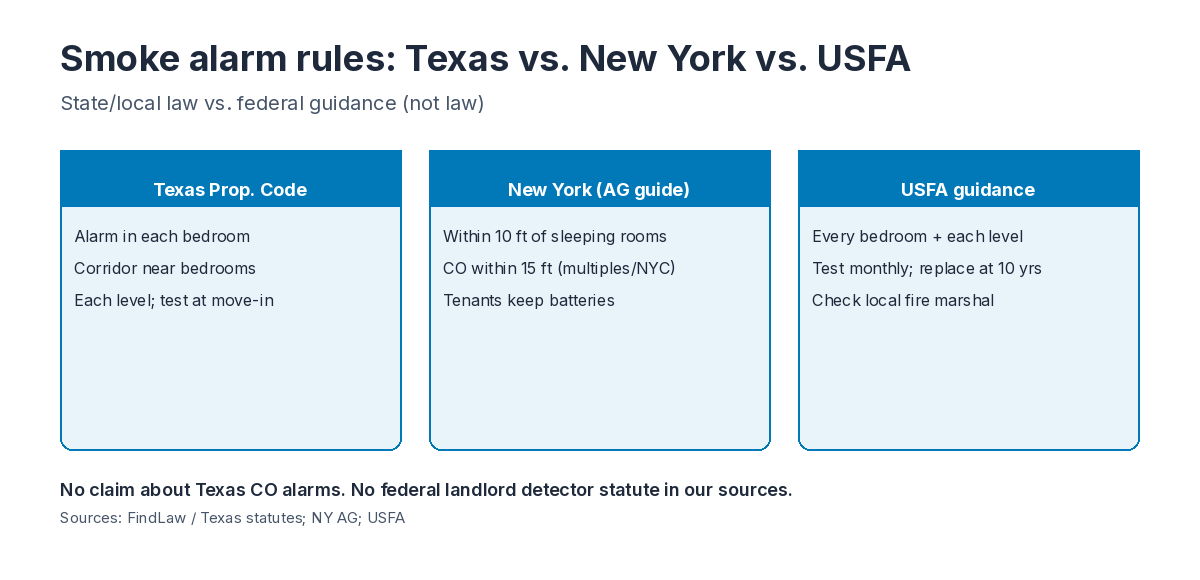
Texas (state-specific): Texas Property Code section 92.255 requires a landlord to install at least one smoke alarm in each separate bedroom in a dwelling unit. Texas Property Code section 92.006(a) says a landlord’s duty to install a smoke alarm under Subchapter F may not be waived.
New York (state-specific): The New York Attorney General’s Residential Tenants’ Rights Guide says landlords of multiple dwellings must install approved smoke detectors in each apartment within ten feet of each room used for sleeping.
Federal guidance, not law: the U.S. Fire Administration says installing smoke alarms in every bedroom, outside each separate sleeping area and on every level of a home, including the basement, is a precaution homeowners and landlords need to take, and that your city, county or state may require a specific type of alarm.
Where do smoke alarms have to go in a rental?
Placement depends on your state. Texas sets bedroom, corridor and each-level rules; New York uses a 10-foot rule for multiple dwellings; USFA guidance matches the every-bedroom pattern.
Under Texas Property Code 92.255, if the unit uses a single room for dining, living and sleeping, the alarm must be inside that room; if multiple bedrooms are served by the same corridor, at least one alarm must be in the corridor in the immediate vicinity of the bedrooms; and if the unit has multiple levels, at least one alarm must be on each level. For units occupied as a residence before September 1, 2011, or issued a certificate of occupancy before that date, alarms installed under that subsection may be battery-powered and need not be interconnected, except replacements of original alarms must meet the building code standards that applied when the unit was first occupied or section 92.252(b).
The New York AG guide says detectors should be clearly audible in each sleeping room. The USFA recommends every bedroom, outside each separate sleeping area and every level.
Do landlords have to install carbon monoxide detectors?
In New York, yes for multiple dwellings and for one- and two-family homes in New York City. Elsewhere, check your state and local code.
New York (state-specific): The New York AG guide says landlords of all multiple dwellings, and one- and two-family homes in New York City, must provide and install an approved carbon monoxide alarm within 15 feet of the primary entrance to each sleeping room. NYC landlords must post an HPD-approved CO notice in a common area. Tenants reimburse $25 within one year for each newly installed CO alarm; combination smoke/CO detectors are permitted, with a $50 reimbursement only when the smoke alarm needs replacing, otherwise $25.
Federal guidance, not law: the USFA carbon monoxide page says CO is colorless and odorless, and advises installing CO alarms in a central location outside each separate sleeping area and on every level of the home. It also cites the Consumer Product Safety Commission that more than 150 people in the U.S. die every year from accidental nonfire-related CO.
Who replaces smoke detector batteries in a rental?
It depends on the state. In Texas, the landlord need not provide batteries after move-in if the alarm worked then; in New York, tenants keep fresh batteries.
Under Texas Property Code 92.258, the landlord shall determine that the smoke alarm is in good working order at the beginning of the tenant’s possession by testing it with smoke, operating the test button or following the manufacturer’s recommended test procedure. The landlord is not obligated to provide batteries for a battery-operated alarm after the tenant takes possession if it worked at move-in; an alarm working at the start of possession is presumed to work until the tenant requests repair.
The New York AG guide says tenants are responsible for keeping fresh batteries in the smoke detector, and may be asked to reimburse the owner up to $10 for a battery-operated detector. The USFA recommends testing monthly and replacing 9-volt batteries at least once a year, and replacing smoke alarms 10 years from the manufacture date.
What must a landlord do when a tenant reports a broken alarm?
Inspect and repair when the tenant gives notice. Texas sets a seven-day written-notice liability trigger; New York has a first-year repair rule for multiple dwellings.
Under Texas Property Code 92.258, during the lease the landlord has a duty to inspect and repair only if the tenant gives notice of a malfunction or requests inspection or repair, and must comply within a reasonable time considering availability of material, labor and utilities. There is no duty for damage or malfunction caused by the tenant, family, guests or invitees, except the landlord must repair or replace if the tenant pays the reasonable cost in advance.
Texas Property Code 92.259 says a landlord is liable if the landlord did not install a required smoke alarm at initial occupancy, or does not install, inspect or repair it on or before the seventh day after the tenant gives written notice that the tenant may exercise remedies if the landlord does not comply within seven days. A written lease may require the tenant’s initial request to be in writing. Section 92.006(a) allows the inspection and repair duty to be waived only by written agreement.
In New York, the AG guide says that during the first year landlords must repair or replace a broken detector if the malfunction is not the tenant’s fault.
What if a tenant disables a smoke alarm?
Texas makes tenants liable for removing batteries without replacing them or for knowingly disconnecting or damaging an alarm, with notice requirements before the landlord’s remedies apply.
Under Texas Property Code 92.2611, a tenant is liable if the tenant removes a battery without immediately replacing it with a working battery, or knowingly disconnects or intentionally damages a smoke alarm. The landlord’s remedies (a court order, a civil penalty of one month’s rent plus $100, court costs and reasonable attorney’s fees) require a lease notice in underlined or boldfaced print and a separate later notice giving the tenant seven days to fix it.
New York’s $10 / $25 / $50 figures in the AG guide are reimbursement amounts for detectors, not penalties for tampering.
Coordinate entry for alarm checks under your state’s entry rules; see can a landlord enter without notice. Add alarm locations to your move-in inspection checklist and put a no-disable clause in the lease; see our lease agreement checklist.
How does Apartment One fit in for landlords?
With detectors documented, you can list for free and receive pre-screened applicants. See also how to find good tenants.
Apartment One is an online platform where renters complete a verified background and credit screening once, then get matched to rental properties they qualify for, while landlords list properties for free and receive pre-screened applicants.
Screening covers credit (FICO 9 from Experian), eviction and criminal records, and landlords can message applicants in-app.
The Tenant Fit Index (TFI) is Apartment One’s 0-100 score matching a renter to a property based on credit, income-to-rent ratio, eviction history, criminal history, and lifestyle preferences. The TFI is a tool used alongside written criteria, not a ranking or a decision-maker.
Apartment One is FCRA-compliant and follows GLBA and CCPA data handling. Data is encrypted, and payments are processed through Stripe.
List your rental for free and get pre-screened applicants.
Frequently asked questions
Can a Texas lease waive the landlord’s duty to install smoke alarms?
No. Texas Property Code 92.006(a) says the duty to install a smoke alarm under Subchapter F may not be waived. Inspection and repair may be waived only by written agreement.
How often should smoke alarms be replaced?
The U.S. Fire Administration recommends replacing smoke alarms 10 years from the manufacture date, and testing them monthly.
Do I have to provide batteries in Texas?
Not after move-in if the alarm worked then. Section 92.258 says the landlord is not obligated to provide batteries for a battery-operated alarm after the tenant takes possession if it worked at move-in.
Where should CO alarms go?
USFA guidance says outside each separate sleeping area and on every level. New York requires an approved CO alarm within 15 feet of the primary entrance to each sleeping room for multiple dwellings and for NYC one- and two-family homes.
Is this legal advice?
No. Check your state statute and local fire marshal before you rely on this.
One Response