

A rental resume is a one-page summary of you as a renter: who is moving, your income and job, your rental history, references and any pets. Include contact details, a short intro, income-to-rent in plain words, your last two or three rentals, and references. Leave off your Social Security number and other sensitive data.
What is a rental resume?
A rental resume is a short introduction that sits on top of the official rental application and screening report; it does not replace either one.
Think of it as a cover page. The landlord’s application collects the formal details, and the screening report shows credit and background results. Your resume tells the story in one place: when you want to move, who lives with you, how you pay rent, and who can vouch for you. For the paperwork itself, see documents needed to rent an apartment, and for what a landlord sees in the background check, see what is a tenant screening report.
Do landlords actually want a rental resume?
Most landlords do not require one, but a clear resume can help when a listing is busy or your situation needs context.
It is most useful for first-time renters, people with thin credit, households with pets, and anyone moving from another city. Renters often apply to more than one place: Zillow’s 2026 Consumer Housing Trends Report found that “The typical (median) recent renter submitted two applications,” and that about 79% of recent renters paid an application fee, with a median fee of $50. A resume you can reuse saves time across those applications.
The Apartment List National Rent Report (October 28, 2026) put the national median rent at $1,384 in October, up 0.1% from a year earlier, and described rents as “still essentially flat compared to one year ago.” A clear introduction still helps you stand out.
What should you include in a rental resume?
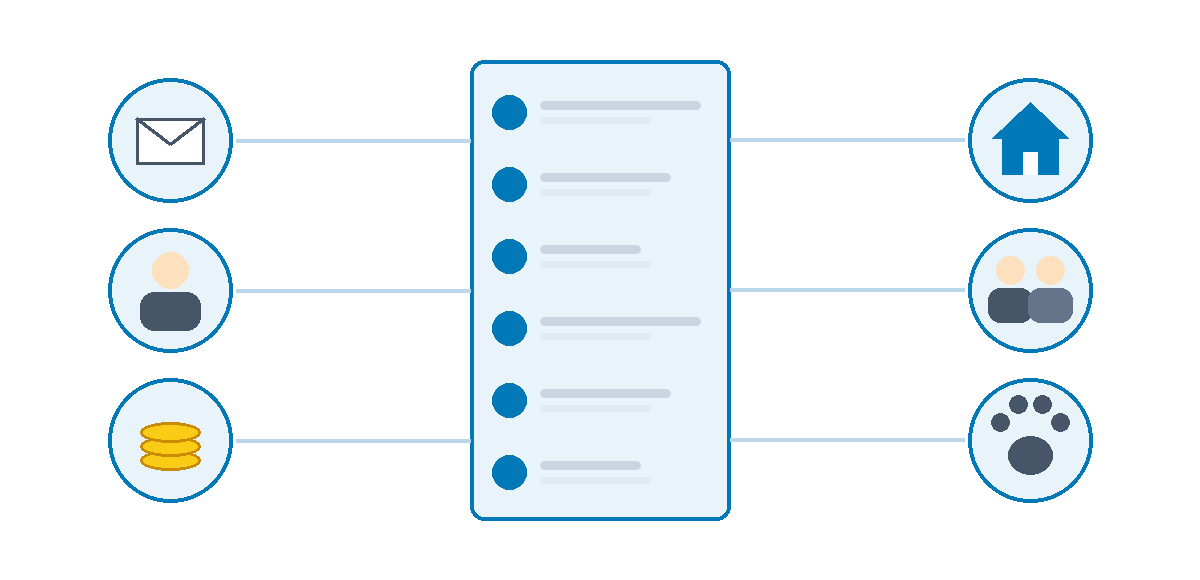
Include six short sections: contact details, a brief intro, income and employment, rental history, references, and an optional pet section.
- Contact details: your name, phone and email. No home address is needed until you apply.
- Short intro: your move-in date, why you are moving, how many people will live there, and any pets.
- Income and employment: employer or income source, how long you have been there, and income-to-rent in plain words (for example, “monthly income is about three times the rent”). Attach proof only when the landlord’s secure application asks for it.
- Rental history: your last two or three places, with dates, city, monthly rent, reason for leaving, and a landlord contact you have permission to share.
- References: a past landlord, employer or personal reference. Ask each person first.
- What you can provide: a line such as “screening report available on request” or “bank statements available if needed.”
What should you leave off a rental resume?
Leave off your Social Security number, date of birth, bank account numbers and photos of your ID.
A resume often goes out early, sometimes to people you have not met. The FTC’s December 2025 Data Spotlight on rental scams warns: “Until you’ve agreed to rent a place, a landlord doesn’t need your Social Security number, credit score or other sensitive information.” The same FTC report adds that “legit landlords normally pull your credit score themselves,” so they do not ask you to get it for them.
You also do not need to describe personal characteristics you would rather keep private. The Fair Housing Act, 42 U.S.C. 3604 prohibits housing discrimination based on race, color, religion, sex, handicap, familial status or national origin, so leave details like these off unless you choose to share them. For what landlords can and cannot ask, see questions landlords can’t ask.
How do you explain bad credit, an eviction or a gap?
Use one honest sentence, say what has changed, and offer proof.
For example: “My credit dropped during a job change in [year]; I have paid rent on time for the past [number] months, and my current landlord can confirm it.” Keep it short and factual, and do not over-explain. For more on low credit, see renting with bad credit, and for a past eviction, see renting with an eviction.
If your score is the weak spot, savings can help tell the story. Apartment One supports Financial Stability Documents, so renters with low credit can show bank funds alongside their screening.
Should you add a pet resume?
Yes, if you have a pet, a short pet section answers a landlord’s questions before they ask.
Pets are common in rentals. Zillow’s 2026 renter report found that “Renter households are more likely to report having at least one pet (55%) than a child (33%).” List each pet’s type, age and size, vaccination status, any training, and a past landlord who can speak to how the pet behaved.
What does a rental resume template look like?
It fits on one page, with headings and fill-in lines you can copy and paste into any document.
Copy the free template below, replace each bracket, and save it as a PDF with your last name in the file name. Send it with your inquiry or application, not instead of it.
RENTAL RESUME: [Your full name]
Phone: [phone] | Email: [email]

ABOUT ME
Move-in date: [date] | Moving because: [reason]
Household: [number of adults, number of children if you choose to share] | Pets: [yes/no]

INCOME AND EMPLOYMENT
[Employer or income source], [role], since [month/year]
Monthly income is about [X] times the rent. Proof available through your secure application.

RENTAL HISTORY
[City], [month/year] to [month/year], $[rent]/month. Reason for leaving: [reason]. Landlord: [name, phone]
[City], [month/year] to [month/year], $[rent]/month. Reason for leaving: [reason]. Landlord: [name, phone]

REFERENCES
[Name], [relationship], [phone or email]
[Name], [relationship], [phone or email]

PET (OPTIONAL)
[Name], [type/breed], [age], [size]. Vaccinations: [up to date]. Training: [details]. Past landlord reference: [name, phone]

WHAT I CAN PROVIDE
Screening report: [available on request or share link]
Additional documents: [bank statements, offer letter, etc.]
How does a shareable screening report fit with your resume?
Your resume introduces you, and a shareable screening report backs it up, so you can point landlords to one report instead of screening again for each application.
Apartment One is an online platform where renters complete a verified background and credit screening once, then get matched to rental properties they qualify for, while landlords list properties for free and receive pre-screened applicants.
Renters screen once for credit (FICO 9 from Experian), eviction and criminal records, and can share the report with landlords. Add a line to your resume saying the report is available, and see apartments you qualify for to focus your search. Quick Screen is $35 one-time for a screening report only, and Tenant Plus is $60 one-time for screening plus access to matched property listings. Pricing can vary by state, so check Apartment One’s pricing page.
The Tenant Fit Index (TFI) is Apartment One’s 0-100 score matching a renter to a property based on credit, income-to-rent ratio, eviction history, criminal history, and lifestyle preferences. The TFI is a tool used alongside written criteria, not a ranking or a decision-maker.
Before you share any report, it helps to know your rights. The CFPB’s guide to reviewing your rental background check says “you are entitled to a free version of your report from the company the landlord used if you request it within 60 days,” and that you can dispute errors with the company that created the check.
Apartment One is FCRA-compliant and follows GLBA and CCPA data handling. Data is encrypted, and payments are processed through Stripe.
Screen once, add your shareable report to your rental resume, and see rentals you qualify for.
Frequently asked questions
Is a rental resume the same as a rental application?
No. The application is the landlord’s official form. A rental resume is an optional one-page introduction you send with it.
How long should a rental resume be?
One page. Use clear headings and short lines so a landlord can scan it in under a minute.
Should I put my credit score on a rental resume?
You do not need to. You can note that a screening report is available and let the report show your credit.
Do I need references if I have never rented?
References still help. Use an employer, a teacher, or another person who knows you well, and ask them first.
Can a landlord require a rental resume?
Some ask for one, but most do not. Check the listing or ask the landlord what they want with an application.