

A tenant screening report is a summary landlords use to decide on applicants. The CFPB says it may include credit reports, rental history, evictions and criminal history. You can ask the screening company for your own file, check each section for errors, and often share one report instead of paying for several.
General information, not legal advice.
What is a tenant screening report?
A tenant screening report is a background report a landlord uses to evaluate you as a renter. According to the CFPB, landlords use these reports “to help make decisions on possible tenants,” and they “may contain information from many sources including your rental history and credit reports.”
The CFPB also notes that many landlords use the report to help decide whether to rent to you and how much to charge for your security deposit. That makes it worth reading your own before a landlord does.
A screening report is different from the landlord’s rules for using it. Our guide to tenant screening criteria explains how landlords write those rules.
What’s in a tenant screening report?
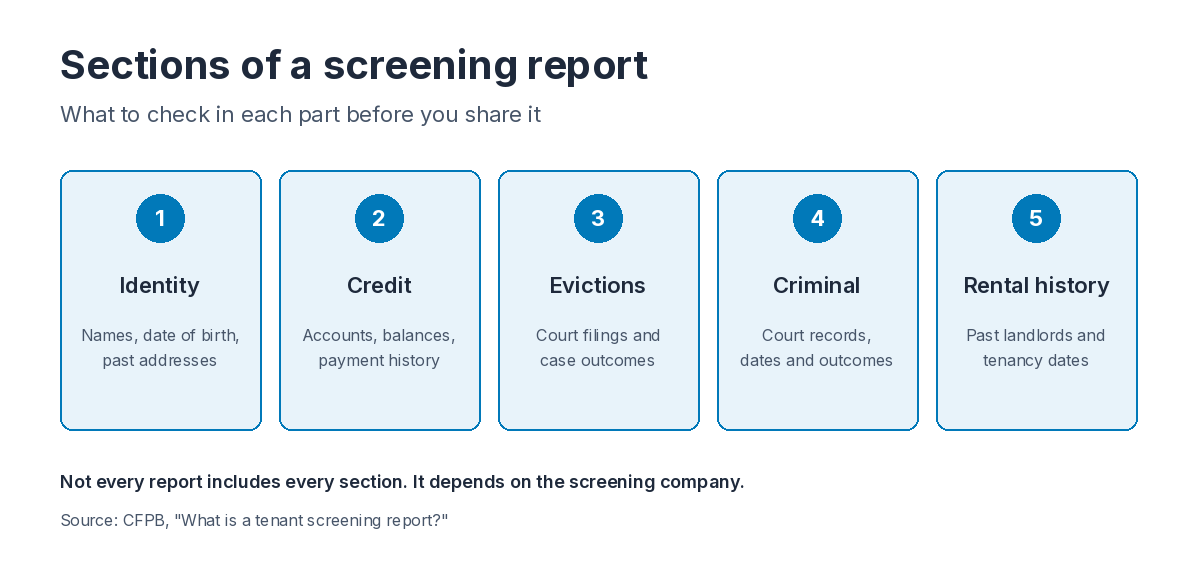
Most tenant screening reports combine identity, credit, eviction, criminal and rental history information. The CFPB lists credit reports, rental history including eviction actions and lawsuits, employment verification, criminal history, sex offender registries, the national terrorist watchlist, and a risk score or recommendation based on criteria the landlord selects.
Not every report includes every section. What you see depends on the screening company and the package the landlord or you order.
| Section | What it shows | What to check |
|---|---|---|
| Identity | Your name, past names, date of birth and addresses | Spelling, every address is yours, no records from someone with a similar name |
| Credit | Accounts, balances, payment history and collections | Accounts you recognize, correct balances, dates of late payments |
| Eviction records | Court filings and lawsuits tied to a rental | Case outcome (dismissed or judgment), dates, the right person |
| Criminal records | Court records the company found | Correct identity, case outcome, how old each record is |
| Rental history | Past landlords, addresses and payment records | Dates of each tenancy, any balance listed, the right property |
For more on how each section is gathered, see our guide to what a background check for an apartment shows.
How do you get a copy of your own report?
Ask the screening company that made it. Under 15 U.S.C. 1681g(a)(1), every consumer reporting agency must, on request, “clearly and accurately disclose to the consumer” all information in your file “at the time of the request.”
Start with the company named by the landlord or on your application. Have your ID ready, since the company will need to confirm who you are before it releases your file.
When you get the file, compare it with your own records. Pull up old leases, pay stubs and bank statements so you can check dates and balances against what the report says. A report that matches your records is one you can share with more confidence.
If a landlord turned you down based on a report, separate rules apply. Our guide on what to do when a rental application is denied covers that situation.
Another option is to screen yourself before you apply. That way you see the same type of information a landlord would, on your own schedule.
How do you read each section of a tenant screening report?
Read it top to bottom and check that every record is yours, is accurate and is recent enough to be reported. Take notes as you go. Mark anything that looks off so you can follow up.
Identity: Check every name and address. A record under a similar name or an address you never lived at can be a sign of a mixed file.
Credit: Look at each account, balance and late payment date. Flag anything you don’t recognize, and compare it with your own records.
Evictions and court records: Check the case outcome, not just the filing. A dismissed case and a judgment are different, and the dates matter.
Criminal records: Confirm the identity details match yours and check the date and outcome of each record.
Under 15 U.S.C. 1681c(a), accounts placed for collection, paid tax liens and most other adverse items older than seven years can’t be reported, but records of convictions of crimes are excepted. The same statute, in 1681c(b), sets exceptions for reports used for credit, life insurance or jobs at certain dollar amounts.
What if something on your tenant screening report is wrong?
Contact the screening company that made the report and ask it to correct the error. Under 15 U.S.C. 1681e(b), a consumer reporting agency must “follow reasonable procedures to assure maximum possible accuracy” of the information in a report.
Before you contact the company, gather what supports your side. Useful records include:
- A copy of the report with the error marked
- Court papers showing a case was dismissed or sealed
- Receipts or bank statements showing a balance was paid
- A lease or move-out letter showing the dates you lived somewhere
Keep copies of everything you send and note the date. Recheck the report after the company responds.
For the step-by-step dispute process, see our guide on rental application denials and disputing a report.
Can you reuse one tenant screening report for several rentals?
Often, yes. You can screen once and share your report, but ask each landlord whether they accept a shared report before you apply.
Reusing one report can cut down on repeat screening fees. Our guide to rental application fees covers what landlords charge and what to ask.
Before you share a report, run through a short checklist:
- Read the whole report yourself first
- Fix or explain any errors before you send it
- Ask the landlord whether they accept a shared report and how recent it must be
- Share it only with landlords you are actually applying to
- Have proof of income ready, since a report alone may not answer every question
Apartment One is an online platform where renters complete a verified background and credit screening once, then get matched to rental properties they qualify for, while landlords list properties for free and receive pre-screened applicants.
Your screening includes credit (FICO 9 from Experian), eviction and criminal records, and you can share your report with landlords. If your credit is low, Financial Stability Documents let you show bank funds.
The Tenant Fit Index (TFI) is Apartment One’s 0-100 score matching a renter to a property based on credit, income-to-rent ratio, eviction history, criminal history, and lifestyle preferences. The TFI is a tool used alongside each landlord’s written criteria, not a ranking or a decision-maker.
Quick Screen is $35 one-time for a screening report only, and Tenant Plus is $60 one-time for screening plus access to matched property listings. Pricing can vary by state.
To see how matching works, read our guide to finding apartments I qualify for. Landlords who want to screen applicants directly can see the Apartment One tenant screening service page. Each landlord still makes its own decision.
Apartment One is FCRA-compliant and follows GLBA and CCPA data handling. Data is encrypted, and payments are processed through Stripe.
Screen once, share one report, and see the rentals you qualify for.
Frequently asked questions
How long is a tenant screening report valid?
It depends on the landlord. Some accept a recent report and others want a new one, so ask each landlord what they accept before you apply.
Can a landlord screen me without permission?
A landlord needs a permissible purpose under 15 U.S.C. 1681b. That can be your written instructions, or a legitimate business need in connection with a transaction you start, such as a rental application. Most applications include a screening authorization, so read what you sign.
How far back does a tenant screening report go?
Under 15 U.S.C. 1681c(a), most adverse items older than seven years can’t be reported, but records of criminal convictions are excepted, and bankruptcies can be reported for up to 10 years.
Is a tenant screening report the same as a credit report?
No. The CFPB says a tenant screening report may include credit reports along with rental history, eviction records, criminal history and other information.
Who can see my tenant screening report?
You can request your own file under 15 U.S.C. 1681g, and a landlord needs a permissible purpose under 15 U.S.C. 1681b, such as your written authorization or a rental application you started. If you screen yourself, you choose who you share it with.
One Response