

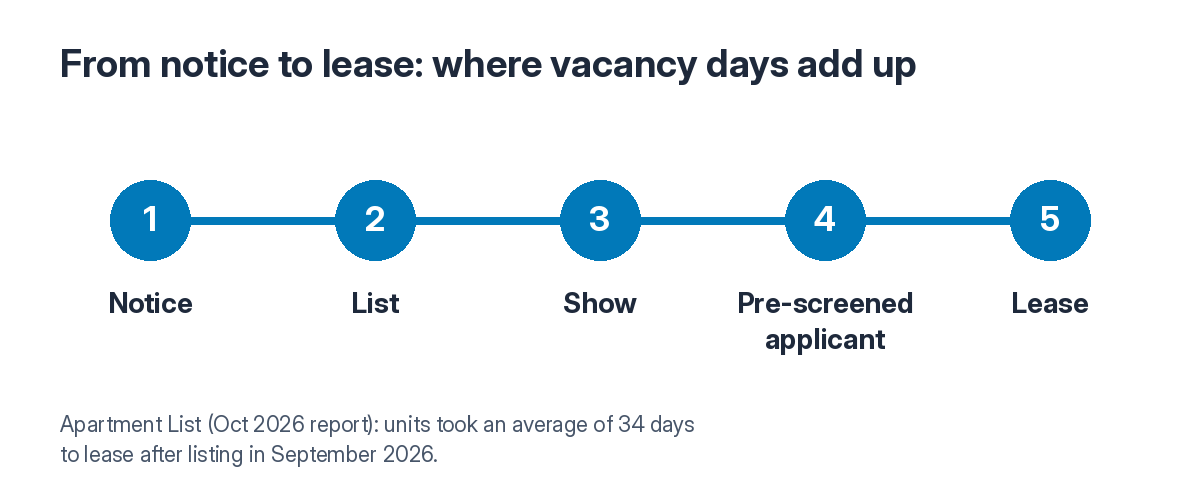
To reduce rental vacancy, start marketing before your current tenant leaves and price against comparable rentals. List with complete photos and written criteria, respond the same day, and shorten screening by working with pre-screened applicants. Speed matters: units took an average of 34 days to lease in September 2026, according to Apartment List.
An empty unit costs you every day it sits. If you are working out how to reduce rental vacancy, the good news is that most of the delay sits in steps you control. Those steps are timing, pricing, the listing itself and how fast you qualify applicants. This guide covers the current market, the cost of vacancy and eight practical ways to fill a unit faster.
What is the rental vacancy rate in 2026?
The U.S. Census Bureau reports that national vacancy rates in the third quarter 2026 were 7.6 percent for rental housing. Apartment List’s separate marketplace index read 7.0% in September 2026.
According to the U.S. Census Bureau’s Housing Vacancies and Homeownership release, national vacancy rates in the third quarter 2026 were 7.6 percent for rental housing.
The Census Bureau said that rate was higher than the third quarter 2025 (7.1 percent) and higher than the second quarter 2026 (7.3 percent).
Apartment List measures something different: vacancy across stabilized properties on its own marketplace. Its October 2026 National Rent Report says that index fell to 7.0% in September after peaking at 7.3% in February, the highest since tracking began in 2017.
Apartment List adds that, at the current pace, it will be over a year before its vacancy rate returns to the 2017-2019 average of 6.4%.
Much of the slack comes from new supply. Harvard JCHS’s “Six Takeaways from America’s Rental Housing 2026” (March 12, 2026) reports that 608,000 multifamily units were completed in 2024, the most since 1986, and 488,000 more were added in 2025.
The same JCHS post says asking rents for professionally managed apartments fell 0.6% year over year in the fourth quarter of 2025.
How much does a vacant unit cost a landlord?
Every vacant day costs you about one day’s rent, plus the bills you keep paying while the unit is empty. A simple formula makes the number concrete.
Lost rent ≈ monthly rent ÷ 30 × days vacant
Plug in your own rent and expected days on market. Then add what you still pay while the unit sits empty, such as utilities, lawn care, insurance and any mortgage interest. Seeing the total makes it easier to judge whether a small price cut or a faster turnover is worth it.
How to reduce rental vacancy: what are the best ways to fill a unit faster?
Most of the time savings come from starting early and removing waiting time at each step. These eight steps are practical recommendations, not guarantees.
1. List before the current tenant moves out
As soon as you have notice and a firm move-out date, start marketing. Check your lease and your state’s rules on notice and showings first.
Renters often decide quickly. RMR Group’s 2026 Renter Insights Survey of Sun Belt renters (October 6, 2026) found that 55% searched for only two to four weeks before signing a lease. If your unit isn’t listed during that window, those renters may never see it.
2. Plan turnover work early
Book cleaning, paint and repairs before move-out day. Walk the unit with the outgoing tenant if you can, so you know what needs work and can line up vendors in advance.
3. Price against comparable rentals
Compare your asking rent with similar nearby units that are actually leasing, not just those sitting on the market. Overpricing by a small amount can cost more in vacant days than it earns in rent.
4. Write a complete listing
Include clear photos of the specific unit, a floor plan if you have one, the rent, fees, pet rules and the move-in date. Renters lean heavily on listing sites. The National Apartment Association reported on May 29, 2026 that 85% of renters in an Apartments.com survey use or plan to use rental listing sites. Compare free rental listing sites for landlords to widen your reach.
5. Respond the same day
Answer inquiries quickly and offer several showing times. A prospect who waits a day for a reply may already be touring somewhere else.
6. Post your screening criteria up front
Publish your income, credit and rental history requirements in the listing. Clear criteria help unqualified applicants self-select out, which saves you review time. Apply the same written standards to everyone.
7. Work with pre-screened applicants
Waiting on each applicant’s report adds days. Starting with renters who have already completed a screening can shorten that step, though you still make the final decision.
8. Widen your applicant pool
Consider renting to Housing Choice Voucher holders. Learn how voucher listings work on our Section 8 housing page.
When is the slowest time to rent, and what should you do?
Fall and winter are the slow season. Fewer renters move, so plan ahead and expect units to take longer to lease.
Apartment List’s October 2026 report says fewer renters tend to move in the fall and winter months, and property owners offer modest discounts to attract demand at this time of year.
That report found units leased in September 2026 had been on the market an average of 34 days, the longest for any September since its tracking began in 2019.
If your lease ends in the off-season, consider timing renewals so future move-outs land in busier months. In the meantime, lean on the steps above, especially early listing and fast responses.
How does screening speed affect days on market?
Screening is often the slowest handoff in the leasing process. Every day spent waiting for reports and documents is a day the unit stays empty.
You can reduce that wait by setting criteria in advance, asking for documents up front and reviewing applicants who already have a screening on file. Keep your process consistent and compliant. Our guide to tenant background check rules covers the FCRA side.
How does Apartment One help landlords fill units?
You list for free, set your criteria and hear from renters who are already screened and meet them. That can cut the time spent on applicants who don’t fit.
Apartment One is an online platform where renters complete a verified background and credit screening once, then get matched to rental properties they qualify for, while landlords list properties for free and receive pre-screened applicants.
The Tenant Fit Index (TFI) is Apartment One’s 0-100 score matching a renter to a property based on credit, income-to-rent ratio, eviction history, criminal history, and lifestyle preferences.
With a free Property Partner listing, applicants arrive pre-screened with FICO 9 credit from Experian, eviction data and criminal data, each with a TFI score. Per the site FAQ, landlords set their screening and eligibility criteria.
You can talk with applicants through in-app messaging. Standard, short-term, senior living, VASH and Section 8 listings are all supported. Screening data is encrypted and handled under FCRA, GLBA and CCPA. Managing property in New Mexico? See our page on property management in Las Cruces.
Cut the wait between listing and lease. List free and get applicants who are already screened.
Frequently asked questions
What is a good vacancy rate for a rental property?
There is no single official “good” number for an individual property. For context, the U.S. Census Bureau reports that national vacancy rates in the third quarter 2026 were 7.6 percent for rental housing. Compare your unit with similar rentals in your area.
Should I lower the rent or offer a concession?
It depends on your market and how long the unit has been empty. A small rent cut lowers income for the whole lease, while a one-time concession keeps the base rent intact. Compare either option with the cost of more vacant days.
How early should I list before a tenant moves out?
List as soon as you have notice and a firm move-out date. Check your lease and your state’s notice and showing rules before you schedule tours.
Does listing on Apartment One cost anything?
No. Property Partner listings are free.
Do pre-screened applicants mean I can skip my own criteria?
No. You set the criteria and make the final decision. You still need to follow fair housing law and apply your standards consistently.
2 Responses