

Yes, you can often rent an apartment with a criminal record. Many landlords look at the type of offense, how long ago it happened and your rental history, and some states and cities limit what landlords can consider. Check your own report first, gather references and proof of income, and ask about each landlord’s criminal-history policy before you apply.
Trying to rent an apartment with a criminal record can feel discouraging, but a record doesn’t automatically rule you out. This guide explains what shows up on a background check and which places have fair chance housing laws. It also covers what to do if you’re denied and how to improve your chances.
If you also have an eviction on your record, read our guide on how to rent an apartment with an eviction.
This article is general information, not legal advice. Laws change and vary by state and city, so check the rules where you’re renting or talk to a legal aid office.
Can a landlord deny you because of a criminal record?
It depends on where you live and how the landlord uses the record. Landlords can generally run criminal background checks, but some state and local laws limit when and how they use them.
Curious how landlords set these rules? See our guide to tenant screening criteria.
Blanket bans can be a problem under federal law. The Federal Trade Commission (FTC) tells landlords that “a blanket policy of refusing to rent to anyone with a criminal record may violate the Fair Housing Act.”
Federal guidance on this topic has changed. HUD withdrew its 2016 guidance on applying the Fair Housing Act to criminal records, effective September 25, 2025, according to a July 17, 2026 Federal Register notice.
State and local laws still apply, and several give renters more protection. The fair chance section below covers examples.
For the landlord side of these rules, see questions landlords can’t ask.
What shows up on a rental criminal background check, and for how long?
Arrests and convictions can both appear, but the time limits differ. The Consumer Financial Protection Bureau (CFPB) explains the rules in its guide to reviewing your rental background check.
Arrests can stay on your report for seven years from the date of entry, unless a longer statute of limitations applies, according to the CFPB.
Convictions are different. The CFPB says “there is no federal time limit for how long criminal convictions can stay on your report, although some states may have different rules.”
Sealed and expunged records shouldn’t show up. The CFPB says records that were expunged or removed from public records should not appear on your report.
Watch for duplicates too. The CFPB warns that one charge can appear multiple times. Different stages of the same case can also show up separately, making it look like you have more than one charge.
Which states and cities have fair chance housing laws?
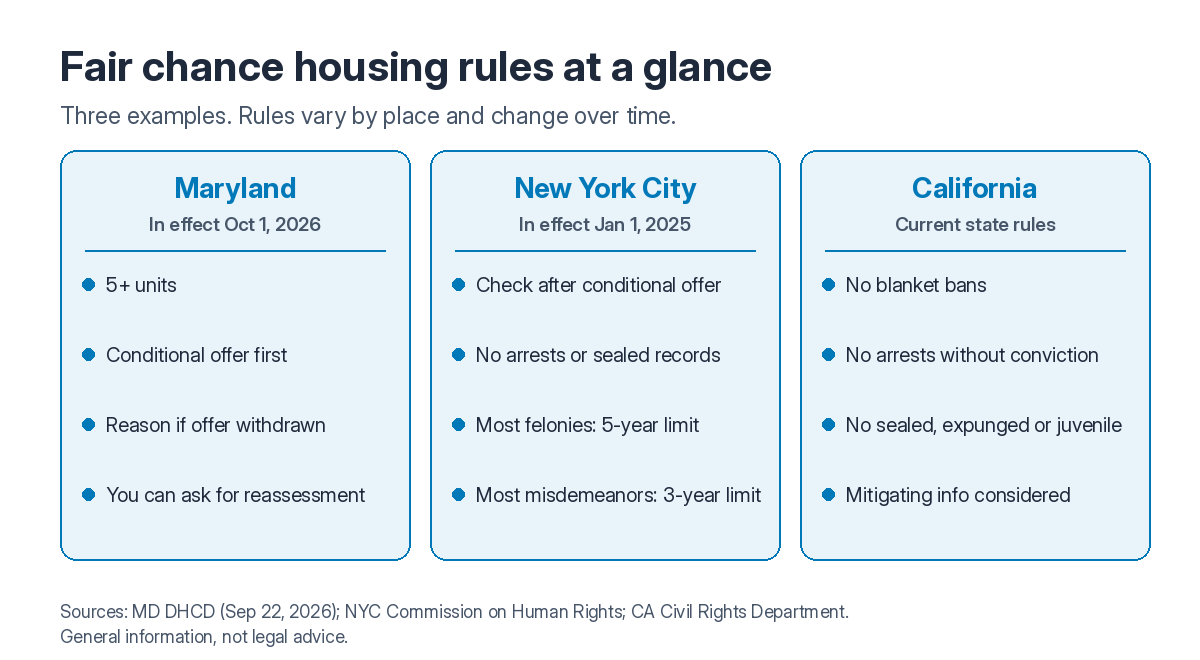
Several do, and the rules differ. Here are three examples confirmed with official sources. Laws change, so check yours.
| Place | In effect | Key rules |
|---|---|---|
| Maryland | Oct 1, 2026 | Providers with 5+ units; conditional offer before a criminal check, with some exceptions; reason given if an offer is withdrawn; you can ask for a reassessment |
| New York City | Jan 1, 2025 | Check only after a conditional offer; no arrests or sealed convictions; most felonies over 5 years and misdemeanors over 3 years can’t be considered |
| California | Current state rules | No blanket bans; no arrests without conviction, sealed or expunged convictions or juvenile records; mitigating information should be considered |
Maryland
Maryland’s Fair Chance Housing Act took effect October 1, 2026, according to a September 22, 2026 notice from the Maryland Department of Housing and Community Development. It applies to housing providers who own or manage five or more units.
The law requires applicants to disclose certain specified convictions if asked. Otherwise, providers generally must make a conditional offer before checking criminal history.
If a provider withdraws the offer because of criminal history, it must give the reason. You can ask for a reassessment and provide more documentation.
The law also bans ads saying applicants with criminal histories won’t be considered. Penalties can reach $500 per violation.
New York City
Since January 1, 2025, covered housing providers can run criminal background checks only after a conditional offer, according to the NYC Commission on Human Rights.
The Commission says providers can’t consider arrests, sealed or expunged convictions, or convictions that were vacated. Most felonies from more than 5 years ago and most misdemeanors from more than 3 years ago are also off-limits. Those time limits run from the release date, or the sentencing date if there was no jail time.
Convictions that require sex offense registration at the time of the check are an exception.
California
California landlords can’t have a policy that bars everyone with a record “no matter the circumstances,” according to a Civil Rights Department (CRD) fact sheet.
The CRD says landlords can’t consider arrests that didn’t lead to a conviction, sealed or expunged convictions, or juvenile adjudications. Landlords should also consider mitigating information.
The state enforces these rules. In a January 13, 2026 settlement, the CRD required Greystar California to revise its screening policies. The goal was to prohibit automatic rejections based on past criminal offenses at the roughly 333 complexes it manages.
How do you check your own background report before you apply?
Look at what landlords will see before they see it. That gives you time to fix errors and prepare an explanation.
Use the CFPB’s checklist. Confirm that misdemeanors and felonies are listed correctly, that sealed or expunged records are gone and that no charge appears twice.
For errors about criminal records, the CFPB says you can contact the court as well as the screening company.
If you’re denied, you can get a free copy of the report the landlord used. The FTC says you have that right if you ask the screening company within 60 days.
You may also be able to seal or expunge an old record. Rules vary by state, so ask a legal aid office where you live about your options.
How can you improve your chances to rent an apartment with a criminal record?
Show the landlord who you are today. Nothing guarantees approval, but these steps can help.
Apply where the policy fits
Ask each landlord about their criminal-history policy before you pay an application fee.
Write a short, honest explanation
A brief letter can give context. The California CRD describes mitigating information as facts that help explain the event and show you’ll be a good tenant. Its examples include your rental history before and after the conviction and evidence of rehabilitation.
Gather references
Letters from past landlords, employers, counselors or program staff can speak to your reliability.
Show steady income or savings
Proof that you can pay the rent matters to every landlord. Bring pay stubs, an offer letter, benefit letters or bank statements.
Consider a co-signer
Someone with steady income who backs the lease can make a landlord more comfortable.
Try smaller or private landlords
Smaller landlords may review applications case by case. See our guide to finding private landlords near you.
What should you do if a landlord denies you?
Ask for the reason and the report. If a screening report played any part in the denial, the FTC says the landlord must give you an adverse action notice.
That notice must name the screening company and its contact details. It must also tell you about your right to dispute errors and to get a free report within 60 days.
Dispute anything that’s wrong. The CFPB says to contact both the screening company and the source of the information, in writing, with copies of supporting documents.
Local laws may give you more rights. In Maryland, you can ask for a reassessment if a conditional offer is withdrawn. In California, you can file a complaint with the CRD.
If you think the law was broken, contact your state or local civil rights agency or a legal aid office. This isn’t legal advice.
Do “felony friendly” or “second chance” apartments really exist?
Some landlords do advertise flexible criminal-history policies. But be careful with paid lists of “felony friendly apartments” and anyone who asks for money before a tour.
Never pay a deposit or fee before you’ve seen the unit and signed a lease. Our guide to rental scams covers the warning signs.
The safest approach is the same everywhere. Ask each landlord directly about their policy, and get the answer in writing if you can.
Does a criminal record affect Section 8 or public housing?
It can, and each public housing agency (PHA) has its own rules. Ask your local PHA about its policy before you apply.
For voucher-friendly rentals, see apartments that accept Section 8.
How does Apartment One help renters with a record?
Apartment One lets you screen once, see your own report and share it with landlords. Landlords make their own decisions.
Apartment One is an online platform where renters complete a verified background and credit screening once, then get matched to rental properties they qualify for, while landlords list properties for free and receive pre-screened applicants.
The Tenant Fit Index (TFI) is Apartment One’s 0-100 score matching a renter to a property based on credit, income-to-rent ratio, eviction history, criminal history, and lifestyle preferences.
Screening covers FICO 9 credit from Experian, eviction records and criminal records. In places with fair chance laws, such as Maryland and New York City, landlords may not be allowed to consider criminal history until after a conditional offer. Ask before you share a full report. The TFI weighs criminal history alongside credit, income-to-rent ratio, eviction history and lifestyle preferences.
If your credit is thin, Financial Stability Documents let you show bank funds as well. You can message landlords in the app.
Quick Screen costs $35 one-time, and Tenant Plus costs $60 one-time. Apartment One is FCRA-compliant and follows GLBA and CCPA data handling. Payments run through Stripe, and your data is encrypted.
Your record is one part of your story. Screen once with Apartment One, see your own report and share it with landlords.
Frequently asked questions
Will a misdemeanor stop me from renting?
Not necessarily. It depends on the landlord’s policy and local law. In New York City, for example, most misdemeanor convictions from more than 3 years ago can’t be considered.
Can a landlord see an arrest that didn’t lead to a conviction?
Arrests can stay on a report for up to seven years, according to the CFPB. But California and New York City bar landlords from considering arrests that didn’t lead to a conviction.
Can a landlord see expunged or sealed records?
They shouldn’t appear on your report, according to the CFPB. If they do, dispute them with the screening company.
How long after a felony can I rent an apartment?
There’s no single federal answer. The CFPB says there’s no federal time limit on reporting convictions. Some local laws set lookback limits, such as 5 years for most felonies in New York City.
Does Apartment One accept renters with a criminal record?
Any renter can screen with Apartment One. Criminal history is one of several Tenant Fit Index factors, and landlords make the final decision.
General information, not legal advice.
2 Responses