

Whether you can refuse Section 8 vouchers depends on your state and city. Source of income discrimination rules ban turning people away because of lawful income such as a Housing Choice Voucher in many places, but the federal Fair Housing Act does not list source of income. Check your local law before you write a no-voucher policy or ad.
General information, not legal advice. Check your state and local law.
What is source of income discrimination?
Source of income discrimination is treating a renter differently because of how they pay, such as turning down a Housing Choice Voucher, Social Security or other lawful, verifiable income. It usually shows up as a blanket “no vouchers” rule, different deposits or criteria for voucher holders, or an ad that says Section 8 is not welcome.
The federal Fair Housing Act does not list source of income as a protected class. Under 42 U.S.C. 3604(b), it is unlawful to discriminate in the terms, conditions or privileges of rental because of race, color, religion, sex, familial status or national origin. Section 3604(f) separately prohibits discrimination in rental because of a handicap.
So most voucher protections come from state and local source of income laws, not from a single federal source-of-income ban. Those laws vary, and some cover vouchers while others do not.
If you are a renter looking for voucher-friendly housing, see our guide to apartments that accept Section 8.
Where is it illegal to refuse Section 8 vouchers?
It is illegal where your state or city has a source of income law that covers housing vouchers. There is no single national list that replaces checking your own jurisdiction.
According to the Housing Solutions Lab (last updated July 31, 2026), as of 2026, 19 states, the District of Columbia, Guam, and many localities had such laws in place.
The Poverty & Race Research Action Council’s Appendix B (updated March 2026) compiles state and local laws that bar source of income discrimination. PRRAC estimates that with Michigan added in 2025, it is likely that over 60% of voucher holders are now protected.
According to the same PRRAC Appendix B, Michigan added source of income to its Landlord-Tenant Relationship Act for landlords with five or more rental units, and the law explicitly covers Housing Choice Vouchers and HUD-VASH.
In California, the PRRAC Appendix B says Cal. Gov’t Code section 12955 makes source of income discrimination unlawful, and since a 2019 change the definition includes Housing Choice Vouchers.
In Delaware, the PRRAC Appendix B says SB 293 (2024) removed the exemption that left voucher holders unprotected, and that the new protections were set to take effect in January 2026 once unified PHA procedures were adopted. This post does not claim the rule is being enforced; confirm on a Delaware government page.
These are examples, not a complete list. Always check your state and city, because local rent and fair housing rules can be stricter or carve out small landlords.
For the program side of accepting vouchers, see our guide to becoming a Section 8 landlord. For veteran vouchers, see HUD-VASH for landlords.
Does Las Cruces have a source of income law?
Yes. According to the PRRAC Appendix B, Las Cruces Ordinance 3045, enacted August 21, 2023, defines source of income to include housing choice vouchers and other rent assistance.
The PRRAC summary of Ordinance 3045 says it is unlawful to refuse to rent, set different terms, or publish an ad indicating a preference based on lawful source of income.
Albuquerque has its own rule. The PRRAC Appendix B describes Albuquerque’s ordinance as making it unlawful, when checking minimum income, to exclude any lawful and verifiable source of income, and to impose extra requirements on subsidized tenants (such as extra deposits) not imposed on others, while still allowing income, credit, background and rental-history checks used for all tenants.
If your rental is elsewhere in New Mexico or in another state, look up the city and county ordinances that apply to that address. Do not assume Las Cruces or Albuquerque rules travel with you.
How should you apply income requirements to a voucher holder?
Apply the same written income standard to every applicant, and where local law says so, count the voucher and other lawful income when you test ability to pay. Never invent a higher income multiple only for voucher holders.
Albuquerque’s approach, as summarized in the PRRAC Appendix B, is a useful model even outside that city: do not exclude lawful, verifiable income from a minimum-income calculation, and do not add deposits or insurance rules that other tenants do not face.
In practice:
- Write the income rule before you list the unit.
- Decide whether the standard applies to the tenant’s share of rent, the full rent, or another formula your local law allows.
- Apply that rule the same way to voucher and non-voucher applicants.
- Document how you counted each income source.
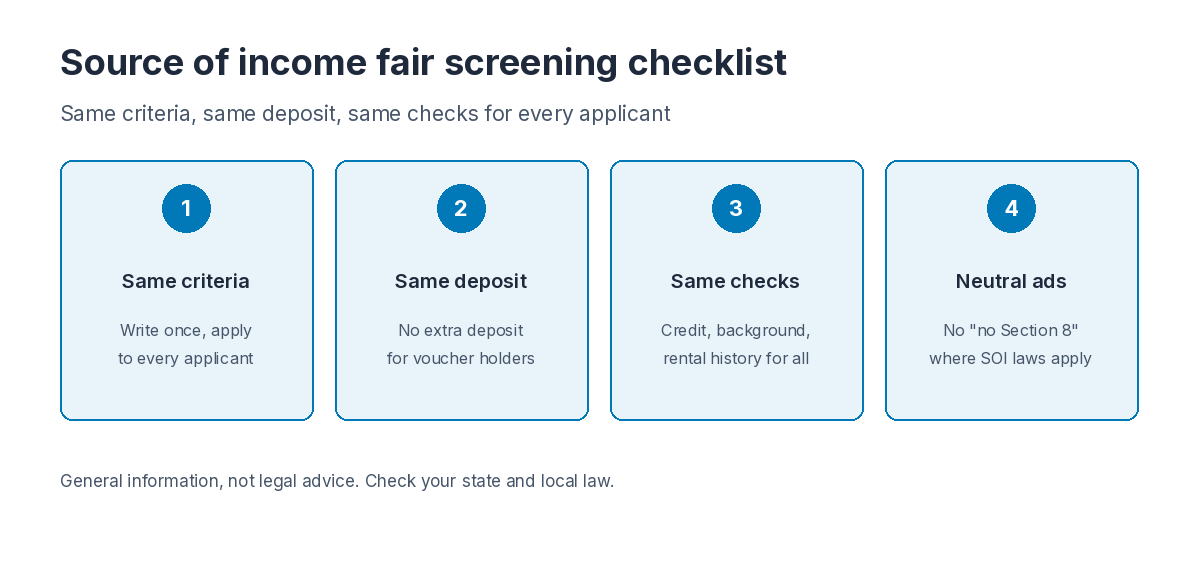
| Screening step | Same for every applicant? | Voucher-specific caution |
|---|---|---|
| Income standard | Yes, use the written rule | Where local law requires it, count the voucher and other lawful income |
| Security deposit | Yes | Do not demand a larger deposit only because rent is subsidized |
| Credit / background / rental history | Yes, same criteria | Do not add extra checks only for voucher holders |
| Advertising | Yes, neutral wording | Avoid ‘no Section 8’ or similar where source of income laws apply |
Our guide to tenant screening criteria explains how to write those standards once and reuse them.
What can you still screen for?
You can still use the same credit, rental history and background checks for every applicant, including voucher holders, as long as the criteria are written and applied evenly. Source of income laws limit why you can refuse someone, not whether you can screen at all.
The PRRAC Appendix B notes that Albuquerque’s ordinance still allows income or credit inquiries and background or rental history checks when those techniques are used for all tenants, regardless of source of income.
Write the criteria first. Use the same report package and the same cutoffs. Keep notes that show you followed the same steps.
For the screening process itself, see our guide to tenant background checks for landlords. For interview and application questions to avoid, see questions landlords can’t ask. For listing language, see how to write a rental listing.
How does Apartment One fit in?
Apartment One helps you list free and receive pre-screened applicants while you keep a written source of income policy that matches your local law. You make every leasing decision.
Apartment One is an online platform where renters complete a verified background and credit screening once, then get matched to rental properties they qualify for, while landlords list properties for free and receive pre-screened applicants.
Screening covers credit (FICO 9 from Experian), eviction and criminal records. Apartment One supports Section 8 rentals and VASH rentals.
The Tenant Fit Index (TFI) is Apartment One’s 0-100 score matching a renter to a property based on credit, income-to-rent ratio, eviction history, criminal history, and lifestyle preferences. The TFI is a tool used alongside each landlord’s written criteria, not a ranking or a decision-maker.
Apartment One is FCRA-compliant and follows GLBA and CCPA data handling. Data is encrypted, and payments are processed through Stripe.
List your rental free, accept every lawful source of income, and get pre-screened applicants.
Frequently asked questions
Can I write “no Section 8” in my rental ad?
Not where source of income laws apply. Las Cruces Ordinance 3045, as summarized by PRRAC, makes it unlawful to publish an ad indicating a preference based on lawful source of income. Use neutral listing language and check your city and state.
Do source of income laws apply to small landlords?
Sometimes not. Some laws exempt smaller owners. Michigan’s rule, as summarized by PRRAC, applies to landlords with five or more rental units. Check the exact exemption language where you rent.
Is source of income a federal protected class?
No. The Fair Housing Act’s protected classes are race, color, religion, sex, familial status, national origin and handicap. Source of income protections come from state and local law.
Can I charge a voucher holder a bigger deposit?
Not where local law bans extra requirements for subsidized tenants. Albuquerque’s ordinance, as summarized by PRRAC, prohibits additional security deposits imposed only on tenants whose rent is subsidized, while still allowing the same checks used for everyone.
Does California protect Housing Choice Voucher holders?
Yes, according to PRRAC’s Appendix B. California’s source of income definition has included Housing Choice Vouchers since a 2019 change to Cal. Gov’t Code section 12955.