

A roommate agreement is a written deal between people who share a home about rent splits, utilities, chores, guests, the security deposit and move-outs. It does not replace your lease. If you all signed one lease, the landlord can usually still hold each of you responsible for the full rent.
General information, not legal advice. Roommate and lease rules vary by state and by whether you share one lease. Talk to a local tenant attorney or legal aid clinic for your situation.
What is a roommate agreement?
It is a written agreement among roommates that sets house rules and money splits so everyone knows the plan before problems come up.
The Tenant Resource Center’s Roommates and You guide (a Wisconsin tenant organization) notes that very little tenant-landlord law deals with roommates, which is why a written agreement matters. It recommends making the agreement detailed and fair, having all roommates sign and date it, and giving everyone a copy.
Think of it as a planning tool between roommates. Your landlord is not usually a party to it.
Does a roommate agreement replace the lease?
No. The lease is the contract with your landlord; a roommate agreement is a separate deal among roommates. It cannot change what the lease says you owe the landlord.
According to the Tenant Resource Center’s Roommates and You guide, roommates who sign the same lease are generally jointly and severally liable. That means the landlord can usually seek the full rent or damages from any one of the tenants, not just a share. Your roommate agreement can say how you will split costs among yourselves and how one roommate repays another, but it does not stop the landlord from pursuing whoever is on the lease.
The Tenant Resource Center’s Roommates and You guide adds that separate leases for each roommate are possible, but landlords are not required to offer them. Ask before you sign if that matters to you.
| Lease | Roommate agreement | |
|---|---|---|
| Who signs | Tenants and landlord | Roommates only |
| Covers | Rent owed, term, rules for the unit | Splits, chores, guests, house rules |
| Can landlord enforce it | Yes | Usually not a party to it |
| Joint liability | Often joint and several on one lease | Cannot remove landlord’s rights |
What should a roommate agreement include?
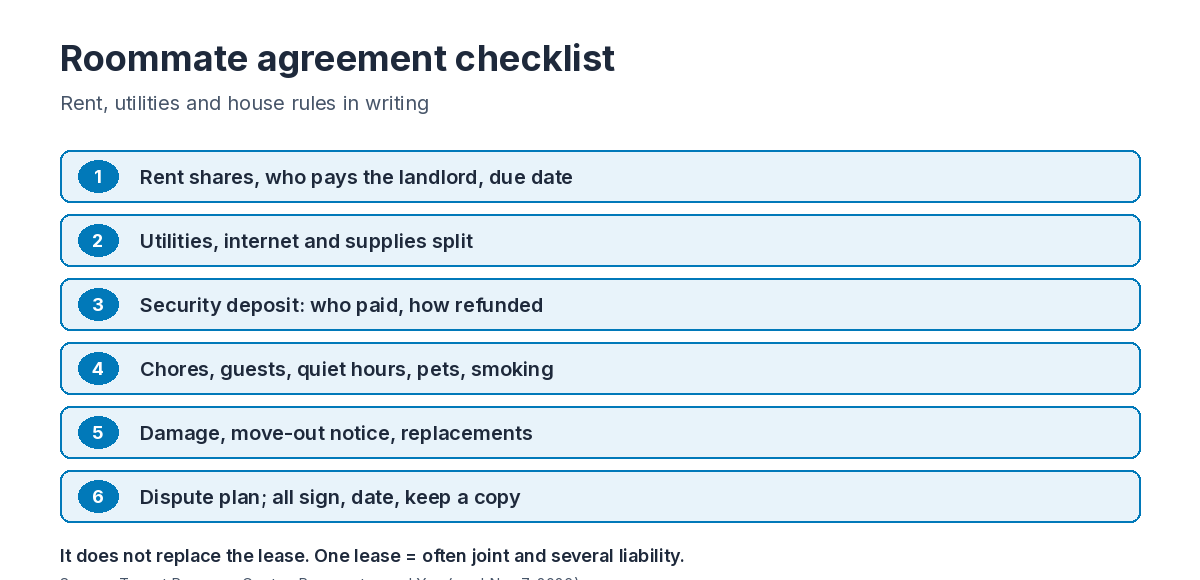
Cover money first (rent, bills, deposit), then daily life (chores, guests, quiet hours, pets, smoking), then what happens when someone leaves or a dispute comes up.
The Tenant Resource Center’s Roommates and You guide lists topics worth covering, including:
- Rent: each person’s share, who pays the landlord, and the due date between you.
- Shared bills: utilities, internet and household supplies, and how they are split.
- Household duties: chores and a schedule.
- Security deposit: who paid what and how it will be divided.
- Destruction of property: who pays for damage.
- Guests and parties: overnight limits and notice.
- Quiet hours, privacy and bedrooms: who gets which room and shared-space rules.
- Shared belongings, smoking and pets.
- Messages and mail.
- Subletting: whether and how anyone may bring in a replacement.
- Dispute resolution: for example, agreeing to talk with a neutral third party.
How should roommates split rent and utilities?
Agree on a written formula, such as equal shares or shares based on room size, and name who pays each bill and by when.
Common approaches (general practice, not legal rules):
- Equal split: simple when rooms are similar.
- Room-based split: a larger room or private bath pays more.
- One payer: one roommate pays the landlord and others reimburse by a set date; put the reimbursement date in writing.
- Utility accounts: list whose name each account is in and how the bill is shared.
Keep records of who paid what. If one roommate falls behind, those records help you sort it out between yourselves, even though the landlord may still look to anyone on the lease.
If a roommate needs a co-signer to qualify, see guarantor for apartment. Application costs for each roommate are covered in rental application fees.
How do you handle the security deposit with roommates?
Write down who contributed to the deposit and how any refund will be divided, and check your state’s rules on how the landlord issues the refund.
Wisconsin example (state-specific): The Tenant Resource Center’s Roommates and You guide notes that under Wisconsin’s ATCP 134.06 (effective November 1, 2015), landlords must follow tenants’ written instructions on how the refund check is issued. Other states handle this differently.
For general deposit timelines and deductions, see security deposit laws.
What happens when a roommate moves out early?
If you share one lease, a roommate who moves out may still be on the hook to the landlord until the lease ends or the landlord releases them. Plan for this in writing.
Your agreement can cover notice to the other roommates, finding a replacement, and how deposit shares transfer. Any replacement usually needs landlord approval under the lease.
The Tenant Resource Center’s Roommates and You guide says roommates can sublet only with the consent of all other roommates, and the lease or local law may require landlord consent as well. Maryland example (state-specific): the Maryland People’s Law Library explains that in a sublease the original tenant stays responsible to the landlord.
If the whole household needs to leave early, see how to break a lease.
What does sample roommate agreement wording look like?
Short, specific sentences work best. Name the person, the amount or task, and the date, so there is little room for different readings later.
Illustrative examples only (adapt them and check your state’s rules):
- “Each roommate pays their share of rent to [name] by the 25th of each month, and [name] pays the landlord by the due date in the lease.”
- “Electric and internet bills are split equally. The account holder posts each bill in our group chat within three days of receiving it.”
- “Overnight guests may stay up to [number] nights per month without the agreement of all roommates.”
- “A roommate who plans to move out gives the others at least [number] days of written notice.”
Review the agreement together when something changes, such as a new roommate, a rent increase or a lease renewal, and have everyone sign the updated version.
How do you choose a roommate before you sign?
Talk through money, schedules and habits before you sign anything, and consider sharing screening reports so everyone knows where they stand.
Our guide on how to screen a roommate walks through questions to ask and what to check. Doing this before you sign a joint lease matters because of joint liability.
How does Apartment One help roommates?
Each roommate can screen once and share the same report with the household and with landlords.
Apartment One is an online platform where renters complete a verified background and credit screening once, then get matched to rental properties they qualify for, while landlords list properties for free and receive pre-screened applicants.
Screening covers credit (FICO 9 from Experian), eviction and criminal records. Quick Screen is $35 one-time for a screening report only, and Tenant Plus is $60 one-time for screening plus access to matched property listings. Pricing can vary by state.
The Tenant Fit Index (TFI) is Apartment One’s 0-100 score matching a renter to a property based on credit, income-to-rent ratio, eviction history, criminal history, and lifestyle preferences. The TFI is a tool used alongside written criteria, not a ranking or a decision-maker.
Apartment One is FCRA-compliant and follows GLBA and CCPA data handling. Data is encrypted, and payments are processed through Stripe.
Screen once and share your report with roommates and landlords.
Frequently asked questions
Is a roommate agreement legally binding?
It may be enforceable between roommates like other written agreements, depending on your state, but it does not bind your landlord or change the lease.
If my roommate does not pay, can the landlord come after me?
Often yes. Roommates on the same lease are generally jointly and severally liable, so the landlord can usually seek the full rent from any tenant on the lease.
Should every roommate sign the agreement?
Yes. The Tenant Resource Center recommends that all roommates sign and date it and keep a copy.
Can a roommate sublet their room?
Only with the other roommates’ consent, per the Tenant Resource Center, and usually with landlord consent under the lease or local law.
Does a roommate agreement replace the lease?
No. The lease is your contract with the landlord. A roommate agreement only covers arrangements among roommates.