

How much rent can you afford? A common guideline is to spend no more than 30% of your gross monthly income on rent. Many landlords also want your gross monthly income to be at least three times the rent. Treat both as starting points. Then check the number against your take-home pay, debts and savings goals.
If you are asking “how much rent can I afford?”, you have probably heard two rules that sound alike. One is the 30% rule. The other is the “3x the rent” rule. They answer different questions, and mixing them up can lead you to a rent that passes a landlord’s screen but strains your budget. This guide shows the math for both and explains when each one applies.
This is general budgeting information, not financial advice.
How much rent can I afford on my salary?
Multiply your gross monthly income by 0.30 to get a 30% rule budget. Divide your gross monthly income by 3 to see the highest rent most “3x” landlords would accept.
Here are the two formulas:
- 30% rule: gross monthly income × 0.30 = suggested rent budget
- 3x rule: gross monthly income ÷ 3 = highest rent under a 3x screen
Have an annual salary instead? Zumper’s rent calculator notes that many landlords ask for an annual salary of 40 times the monthly rent. So annual salary ÷ 40 gives a quick estimate of the same 3x limit.
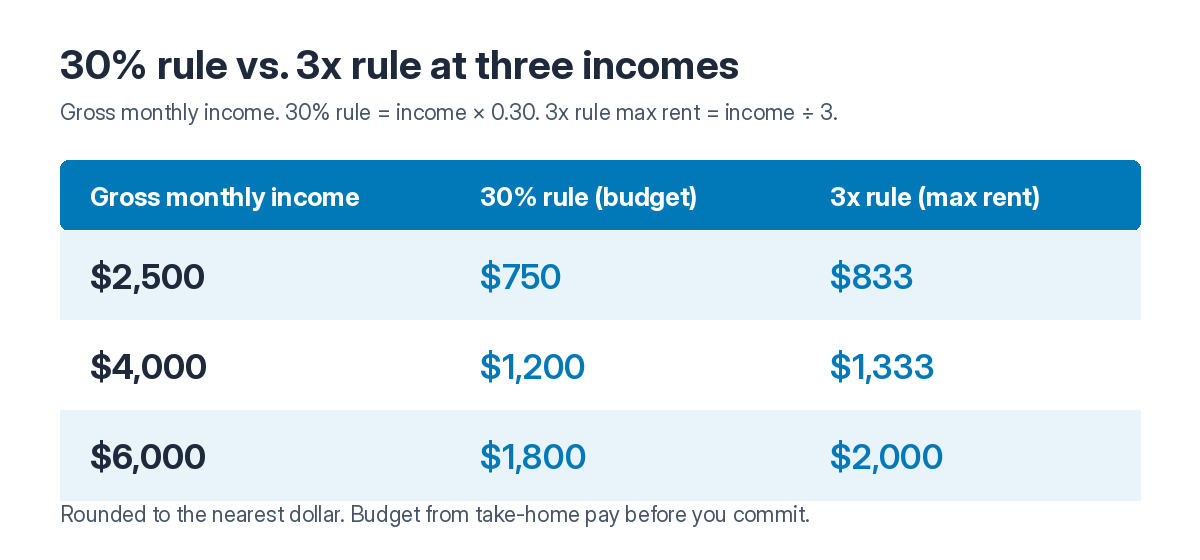
| Gross monthly income | 30% rule (income × 0.30) | 3x rule max rent (income ÷ 3) |
|---|---|---|
| $2,500 | $750 | $833 |
| $4,000 | $1,200 | $1,333 |
| $6,000 | $1,800 | $2,000 |
Notice that the two rules land close together. One third of income is about 33%, so the 3x limit is always a little higher than the 30% budget. That gap matters. A rent can clear a landlord’s 3x screen and still be more than the 30% guideline suggests.
For context, Apartment List’s October 2026 National Rent Report puts the national median rent at $1,388 in September 2026, down 0.4% from a year earlier.
Under the 3x rule, that median rent works out to a gross monthly income of about $4,164.
What is the 30% rule for rent, and is it still realistic?
The 30% rule says rent should take no more than 30% of your gross monthly income. It is a useful starting point, but it does not look at your full financial picture.
The number has a long history. Zumper’s rent calculator explains that the 1969 Brooke Amendment capped public-housing rent at 25% of income, and Congress raised that cap to 30% in 1981.
Equifax’s guide, “Is the 30% Rent Rule Still Relevant?”, says the rule uses gross income and does not account for debts, child care, medical bills or savings goals.
Many renters already pay more than 30%. The Harvard Joint Center for Housing Studies’ State of the Nation’s Housing 2026 (June 17, 2026) found that 22.7 million renter households, or 49%, spent more than 30% of their income on housing in 2024.
That same report found 12.1 million renter households (26%) paid more than half of their income for housing, and the number of cost-burdened renters grew by 2.3 million since 2019.
Harvard JCHS’s “Six Takeaways from America’s Rental Housing 2026” (March 12, 2026) reports that from 2001 to 2024, renter incomes rose 9% in real terms while rents rose 30%.
The same JCHS post says lower-income renters’ residual income after rent has fallen 60% since 2001, to a record low of $210.
So is 30% realistic? For some renters it is a comfortable ceiling. For others, especially on lower incomes, even 30% can leave too little for food and bills.
What is the 3x rent rule landlords use?
The 3x rule is an approval screen, not a budget. Many landlords want your gross monthly income to equal at least three times the monthly rent.
Zumper’s rent calculator gives an example: for $1,800 rent, many landlords would look for $5,400 a month (3x) or $72,000 a year (40x).
Landlords usually measure this against gross income, the amount before taxes. Requirements still vary from one landlord to the next. Some may use a different multiple, count certain income differently or accept a guarantor. Read the listing, and ask the landlord before you pay an application fee.
Should I use gross or net income when budgeting for rent?
Use gross income to see whether you meet a landlord’s screen. Use net, or take-home, pay to decide what you can actually afford each month.
Equifax suggests starting with your take-home pay and working through your budget in order:
- Add up basic needs, such as groceries, utilities, insurance, transportation and phone service.
- Factor in debt payments, including minimum credit card payments, student loans and car loans.
- Set aside money for savings or emergencies if your budget allows.
- Review what is left. That remaining amount is the rent you can afford.
If the number you get is lower than 30% of your gross income, trust the lower number. It reflects the money that actually lands in your account.
What if my income is less than 3x the rent?
You may still have options, but approval is always the landlord’s decision. Zumper’s rent calculator says falling short usually means a guarantor, a co-signer or extra months of rent up front.
- Co-signer or guarantor: someone with qualifying income agrees to cover the rent if you can’t.
- Roommate: combining incomes can lower the share of rent each person carries.
- Extra rent up front: some landlords accept this when income falls short.
- Proof of savings: bank statements can show you can cover the rent.
On Apartment One, Financial Stability Documents let you show bank funds, which may help you qualify when your credit or income looks thin on paper. If credit is the bigger hurdle, read our guide to getting approved with bad credit. Have a voucher? See our guide to apartments that accept Section 8 vouchers.
How does Apartment One use income-to-rent when matching you?
Income-to-rent ratio is one of the factors Apartment One uses to match you with rentals. You screen once and then see properties whose requirements fit your profile.
Apartment One is an online platform where renters complete a verified background and credit screening once, then get matched to rental properties they qualify for, while landlords list properties for free and receive pre-screened applicants.
The Tenant Fit Index (TFI) is Apartment One’s 0-100 score matching a renter to a property based on credit, income-to-rent ratio, eviction history, criminal history, and lifestyle preferences.
Your screening covers FICO 9 credit from Experian, eviction records and criminal records. Tenant Plus ($60, one-time) adds your full profile, a matched feed of rentals and in-app messaging. Quick Screen ($35, one-time) gives you a screening report only. Either report can be shared with landlords. Each landlord still sets its own criteria and makes the final decision. Searching in New Mexico? Browse our apartments for rent in Las Cruces.
Know your number, then see the rentals you already qualify for.
Frequently asked questions
How much rent can I afford on $50,000 a year?
Under the 30% guideline, $50,000 a year is about $4,167 a month in gross income, and $4,167 × 0.30 is about $1,250 in rent. That is a guideline, not advice for your situation. Check it against your take-home pay and debts.
Do landlords use gross or net income?
Many landlords measure the 3x rule against gross income, which is your pay before taxes. Requirements vary by landlord, so check the listing or ask. For your own budget, start from take-home pay.
Does 3x rent include utilities?
It depends on the landlord. Requirements vary, so ask whether the income test uses base rent only or rent plus any fees. Budget for utilities either way.
Can I count savings instead of income?
Some landlords will consider savings or bank funds, but each landlord decides. On Apartment One, Financial Stability Documents let you show bank funds, which may help you qualify when your income or credit falls short.
What does “rent burdened” mean?
Harvard’s Joint Center for Housing Studies calls a household cost-burdened when it spends more than 30% of income on rent and utilities. Severely burdened households spend more than 50%.
6 Responses