

Tenant screening criteria are the written minimum standards every applicant must meet, such as income-to-rent ratio, credit, rental and eviction history, and any criminal-history rules allowed where you rent. Write them before you list and share them with applicants. Apply them the same way to everyone, and process applications in the order you receive them.
Good tenant screening criteria protect you twice. They help you find renters who can pay, and they give you a consistent, documented process if a decision is ever questioned. This guide covers what to include, how to choose between qualified applicants and where criminal-history rules differ.
For what a background check includes and the FCRA steps, see our tenant background check guide for landlords.
This article is general information, not legal advice. Screening rules vary by state and city, so have an attorney review your policy.
What are tenant screening criteria?
They’re the objective standards you use to decide whether an applicant qualifies for your rental. Writing them down is what makes them work.
The California Apartment Association (CAA) says every landlord should develop written screening criteria before offering a property for rent. Its “Screening: Establishing Criteria” paper (revised December 2024) says to apply them consistently to all applicants.
According to CAA, criteria should include minimum income requirements, credit, employment and other objective criteria.
Some qualified applicants won’t have pay stubs. See what renters can show instead in our guide to renting an apartment without proof of income.
The CAA paper also warns about subjective screening. It says landlords who rely on “gut instinct” often face costly mistakes.
What should a rental criteria policy include?
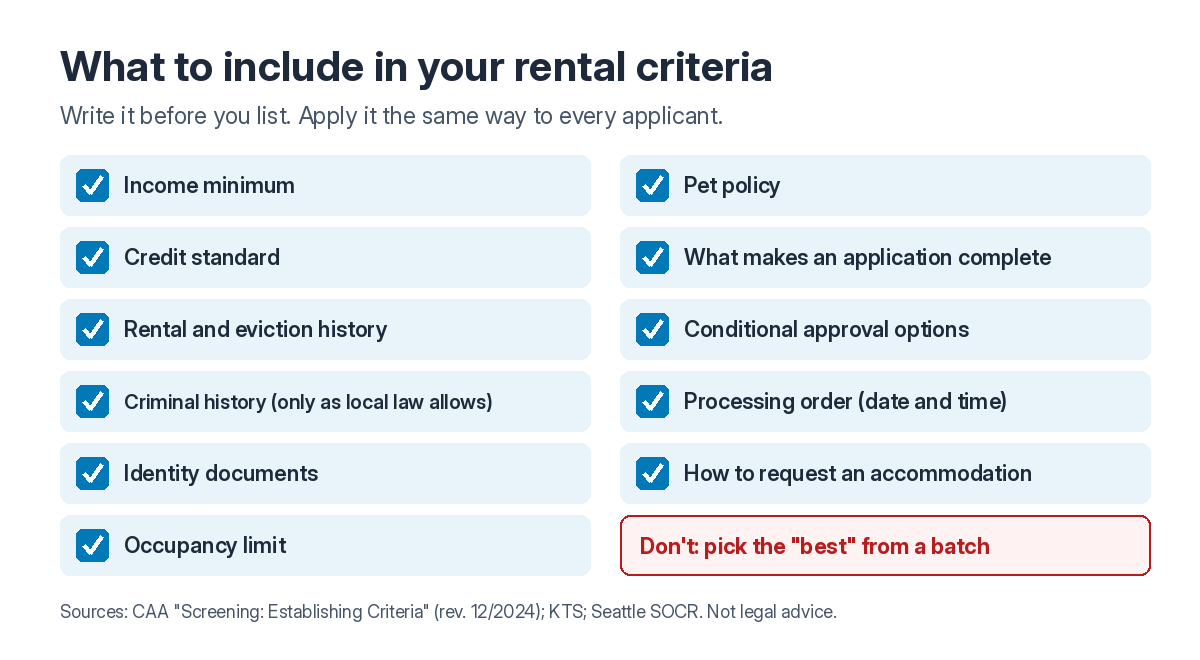
Cover every factor you’ll use to say yes or no, plus how you’ll process applications. Use this checklist as a starting point. The example wording is illustration only, not a recommended standard.
| Criterion | Example wording | Notes |
|---|---|---|
| Income | “Gross household income of at least [X] times the monthly rent” | You choose X. List the documents you accept. |
| Credit | “No open collections for rent or utilities” | Define “good credit” specifically. |
| Rental and eviction history | “No eviction judgment in the past [X] years” | Check local limits on eviction records. |
| Criminal history | Only as your state and city allow | No blanket bans. Some places require a conditional offer first. |
| Identity | “Government-issued photo ID” | Ask every applicant for the same ID types. |
| Occupancy | “Maximum [X] occupants” | Follow local occupancy codes. |
| Pets | “Up to [X] pets, [size or type]” | List any pet fees or limits. |
| Complete application | “All listed documents and fees received” | Define “complete” so order is clear. |
| Conditional approval | “Applicants within [X] of the income minimum may qualify with a co-signer” | Put the conditions in writing. |
| Processing order | “Complete applications are reviewed in the order received” | Note the date and time on each one. |
| Reasonable accommodation | “To request an accommodation, contact [name or email]” | Tell applicants how to ask. |
For which income documents to request and how to check them, see how to verify tenant income.
How do you set the minimum standards?
Set them based on the risk you’re willing to take, then write them down as clear thresholds. There’s no single national standard for income or credit.
If you want more financially stable residents, raise the written bar instead of comparing applicants. Law firm Kimball, Tirey & St. John (KTS) gives that advice in a September 2014 article. It suggests raising the required income-to-rent ratio, for example.
You can also build in documented flexibility. CAA says some flexibility is possible “as long as it is justified and documented.”
CAA’s example is an applicant at the low end of the income minimum. A landlord could require that applicant to have a higher credit score or pay a larger deposit.
Whatever you choose, make it specific. “Good credit” means different things to different people, so define it.
What do you do when several applicants qualify?
Offer the unit to the first qualified applicant. That’s the approach both CAA and KTS recommend.
CAA says landlords should rent to the first applicant who meets the screening criteria, “rather than the one who seems ‘best’ qualified.” It also says to note the date and time on each application. Then process applications in the order received.
KTS recommends a policy of “first come, first qualified, first served.” It says chronological order is the most neutral, objective way to process applications.
Some cities require it. Seattle’s first-in-time FAQ (Seattle Office for Civil Rights, November 2019) says landlords must screen completed applications in chronological order.
Under those rules, the first qualified applicant gets 48 hours to accept. If they decline or don’t respond, the landlord may move to the next applicant in line. Check Seattle’s current rules if you rent there.
Why not just pick the “best” applicant? KTS calls that practice “batching.” It says batching “is not presently illegal” but “can sometimes raise potential fair housing concerns,” because it invites subjectivity.
What is conditional approval, and when do you need an adverse action notice?
Conditional approval means offering the unit with conditions, such as a co-signer or a larger deposit. KTS suggests offering it to applicants who conditionally qualify, with the conditions written into your criteria.
Conditions can trigger a notice. The Federal Trade Commission (FTC) lists requiring a co-signer or a larger deposit as examples of adverse actions.
If a consumer report played any part in that decision, you must give the applicant an adverse action notice. The FTC says this applies even if the report played only a small part.
Our background check guide covers what the notice must include.
Can screening criteria include criminal history?
It depends on where your rental is. Federal, state and local rules all apply, and some places limit when and how you can check.
Blanket bans are risky everywhere. The FTC says “a blanket policy of refusing to rent to anyone with a criminal record may violate the Fair Housing Act.”
Maryland’s Fair Chance Housing Act took effect October 1, 2026, for housing providers with five or more units, per the Maryland Department of Housing and Community Development (September 2026). Covered providers generally must make a conditional offer before checking criminal history. They also can’t advertise that they won’t consider applicants with criminal histories.
New York City has a similar rule. The NYC Commission on Human Rights says that since January 1, 2025, covered providers can run criminal background checks only after a conditional offer.
Older federal guidance has changed. HUD withdrew its 2016 guidance on applying the Fair Housing Act to criminal records, effective September 25, 2025, according to a July 17, 2026 Federal Register notice. The Fair Housing Act itself and state and local laws still apply.
Check your state and city rules before you add criminal history to your criteria.
What can’t go in your screening criteria?
Anything based on a protected class under federal, state or local fair housing law. In some places, that includes the applicant’s source of income.
As of 2026, 19 states, D.C., Guam and many localities had source-of-income laws, according to the Housing Solutions Lab. Many of these laws also cover housing vouchers.
For questions and ad wording to avoid, see questions landlords can’t ask. If you accept vouchers, read how to become a Section 8 landlord.
Should you publish your criteria in the listing?
We suggest it. Sharing your criteria up front saves time for you and for applicants who don’t qualify.
CAA says giving written criteria to each prospective resident “may encourage those individuals with poor credit or problematic rental history to look elsewhere.”
Some places require notice. Seattle’s FAQ says landlords must tell applicants the minimum criteria and required documents before collecting their information.
California has a fee rule too. CAA says that since January 1, 2025, landlords who charge a screening fee must choose one of two policies.
The first is “first qualified, first approved,” with written criteria provided with the application. The second is refunding the fee to applicants who aren’t selected, within 7 days of selecting an applicant.
To spread the word, see our list of free rental listing sites for landlords.
How does Apartment One fit into a written screening policy?
Apartment One gives you a consistent screening report for every applicant. You still set and apply your own written criteria.
Apartment One is an online platform where renters complete a verified background and credit screening once, then get matched to rental properties they qualify for, while landlords list properties for free and receive pre-screened applicants.
The Tenant Fit Index (TFI) is Apartment One’s 0-100 score matching a renter to a property based on credit, income-to-rent ratio, eviction history, criminal history, and lifestyle preferences.
Every applicant comes with the same pre-screening: FICO 9 credit from Experian, eviction records and criminal records. If your rental is covered by a fair chance law, such as Maryland’s or New York City’s, ask your attorney when you’re allowed to review an applicant’s criminal history. Each also has a Tenant Fit Index score for your property.
Use the TFI as a quick view of fit, next to your written minimums. Don’t use it to compare qualified applicants against each other. Check each complete application against your criteria in the order received.
Listing as a Property Partner is free, and you can message applicants in the app. Apartment One is FCRA-compliant and follows GLBA and CCPA data handling.
Apartment One doesn’t write your policy or make you fair-housing compliant. You make the decisions.
Write your criteria once and apply them to every applicant. List free on Apartment One and receive pre-screened applicants, each with a Tenant Fit Index score for your property.
Frequently asked questions
Do I have to rent to the first qualified applicant?
Not under federal law, but some cities require it, such as Seattle under its first-in-time rules. KTS and CAA both recommend it as a practice. Check your local law.
Can I have different criteria for different units?
In Seattle, the first-in-time FAQ says different criteria for different units aren’t prohibited. Applicants for the same unit must be screened by the same criteria. Rules elsewhere may differ.
What credit score should I require?
There’s no standard. It’s your business decision, so pick a specific threshold and write it down.
Do I need to give applicants my criteria in writing?
It’s required in some places, such as Seattle. In California, CAA says landlords who charge a screening fee under the first-qualified option must provide written criteria with the application. It’s good practice everywhere.
Does Apartment One cost landlords anything?
No. Listing is free through the Property Partner program.
General information, not legal advice.
8 Responses