

Most landlords ask for a photo ID, proof of income, a Social Security number or accepted alternative, rental history, employment verification, and funds for the deposit. Some also ask for renters insurance, pet paperwork or a guarantor. Requirements vary by property and state, so pack the common items once and confirm each listing before you pay to apply.
General information, not legal advice. Document requirements vary by property and state.
What documents do you need to rent an apartment in 2026?
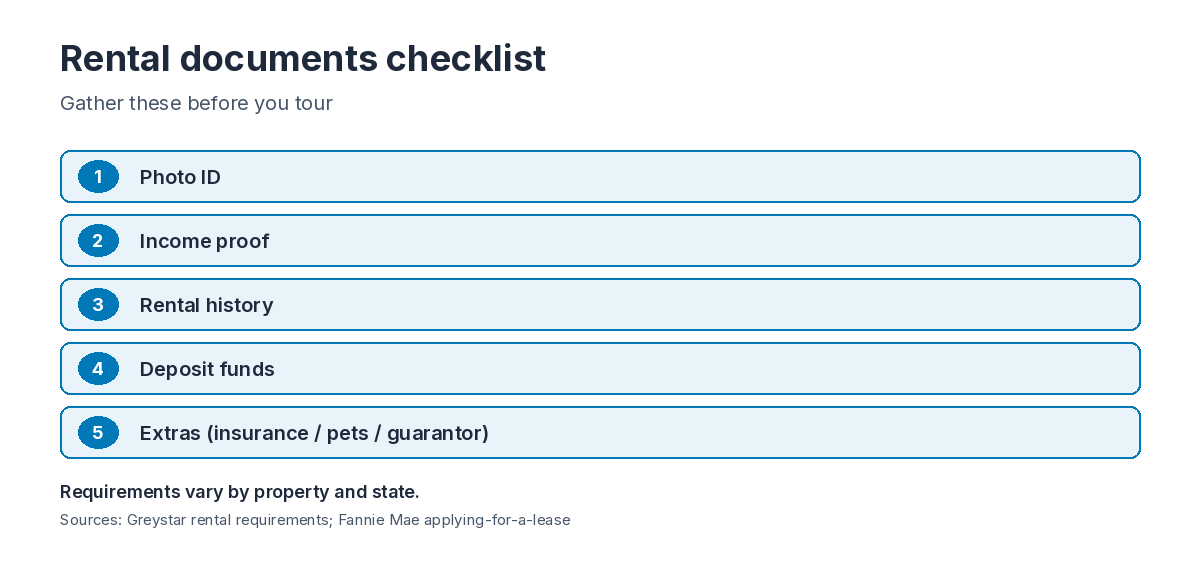
Plan on a photo ID, income proof, SSN or an accepted alternative, rental history, employment verification, deposit funds, and any insurance, pet or guarantor paperwork the property lists. Exact lists still vary by property, state and residency status.
According to Greystar’s rental requirements page, one large apartment manager commonly requests proof of income, photo ID, a Social Security number or an alternative for international applicants, rental history, employment verification, a security deposit, renters insurance if required, pet documentation if applicable, and guarantor information if income does not meet the property minimum.
Fannie Mae’s “What to Know Before Applying for a Lease” similarly says landlords commonly ask for government-issued ID and employment status, proof of income such as recent paystubs or an offer letter, and that they often run credit and criminal background checks.
Gather these before you tour so you are not scrambling after you find a unit you like.
| Document | Why landlords ask | Pack this |
|---|---|---|
| Photo ID | Confirm identity | Driver’s license, passport or state ID |
| Income proof | Show you can pay rent | Recent pay stubs, tax returns, bank statements or assistance docs |
| SSN or alternative | Background and credit checks | SSN, or visa / green card / ITIN if accepted |
| Rental history | Payment and occupancy record | Prior manager references or a rental ledger |
| Employment letter / stubs | Confirm job and income | Offer letter or recent pay stubs |
| Deposit funds | Secure the unit | Amount the property quotes for security deposit |
| Extras if asked | Lease conditions | Renters insurance, pet vaccines/breed info, guarantor packet |
What proof of income do landlords usually accept?
Recent pay stubs are the most common, but tax returns, bank statements, government assistance documents and offer letters are also widely used, and self-employed or gig workers often use bank statements and 1099s.
Greystar lists recent pay stubs, tax returns, bank statements or documentation of government assistance as common proof of income, and notes that providing multiple months of documentation can strengthen an application.
Fannie Mae says proof of income may include recent paystubs or an employment offer letter, and that small-business or gig workers may verify income through bank statements, 1099 tax forms and similar methods. If you are not employed, Fannie Mae notes a landlord may accept bank statements showing funds to cover the lease period.
For how landlords review income on their side, see how to verify tenant income. If you lack traditional pay stubs, see renting without proof of income and ask whether the property accepts bank-funds or Financial Stability Documents paths. Never assume approval.
What ID and personal information will you be asked for?
Expect a government-issued photo ID, and most offices also ask for a Social Security number or an accepted alternative such as a visa, green card or ITIN for international applicants.
Greystar lists a valid driver’s license, passport or state-issued ID, and says most leasing offices require an SSN for background and credit checks. For non-U.S. residents, Greystar’s FAQ says a visa, green card or Individual Taxpayer Identification Number (ITIN) may be accepted.
Fannie Mae says a government-issued ID, like a driver’s license, is typically required along with your employment status.
What rental history and employment documents help?
Prior property-manager references, a rental ledger, an offer letter and recent pay stubs are the documents managers most often use to confirm you paid on time and that your job is real.
Greystar lists previous property manager references or a rental ledger for rental history, and a job offer letter or recent paycheck stubs for employment verification. Some managers may also call your employer.
Fannie Mae likewise points to employment status and paystubs or an offer letter as common application elements.
What else might the property ask for before move-in?
Many properties also require a security deposit, proof of renters insurance, pet paperwork if you have animals, and guarantor documents if your income is below the property minimum.
Greystar lists a security deposit, renters insurance when required, pet vaccinations and breed information plus any pet deposits or fees, and guarantor information when income does not meet the minimum.
For deposit rules by state, see security deposit laws. If you need a guarantor, see guarantor for an apartment.
How do you avoid paying application fees over and over?
Ask for the fee amount and the written screening criteria before you apply, then screen once and focus on places you already match so you are not paying at every door.
Fannie Mae says application fees can range from approximately $35 to $75 or more per property, and that applying at multiple locations can mean paying multiple fees. Fannie Mae also notes that some apartment search sites let you complete one application that can be used at multiple properties.
Ask the fee and criteria first. Our guides on rental application fees and apartments you qualify for cover what to ask and how to narrow the list. For the full first-rental process, see how to rent your first apartment.
How does Apartment One fit in?
Apartment One lets you pack your documents once, complete a verified screening once, and share a report with landlords instead of starting from scratch at every property. You still decide where to apply, and screening never promises approval.
Apartment One is an online platform where renters complete a verified background and credit screening once, then get matched to rental properties they qualify for, while landlords list properties for free and receive pre-screened applicants.
Screening covers credit (FICO 9 from Experian), eviction and criminal records. You can share your report with landlords. If credit is thin, Financial Stability Documents can help you qualify on bank funds where a landlord accepts that path.
See our guide to the tenant screening report for what that file usually includes.
The Tenant Fit Index (TFI) is Apartment One’s 0-100 score matching a renter to a property based on credit, income-to-rent ratio, eviction history, criminal history, and lifestyle preferences. The TFI is a tool used alongside written criteria, not a ranking or a decision-maker.
Quick Screen is $35 one-time for a screening report only, and Tenant Plus is $60 one-time for screening plus access to matched property listings. Pricing can vary by state.
Apartment One is FCRA-compliant and follows GLBA and CCPA data handling. Data is encrypted, and payments are processed through Stripe.
Pack your documents once, screen once, and apply where you already match.
Frequently asked questions
Do I need three months of pay stubs?
Often helpful, but not a universal rule. Greystar notes that providing multiple months of income documentation can strengthen an application, so ask the property how many stubs it wants.
Can I rent without a Social Security number?
Sometimes. Greystar says a visa, green card or ITIN may be accepted for international applicants. Ask the leasing office what it will take.
Do I need renters insurance to apply?
Not always to apply, but many communities require proof of insurance by lease or move-in. Greystar says some properties require it.
What if I have no traditional income proof?
Ask whether bank statements, 1099s or assistance documents are accepted. See our guide on renting without proof of income, and ask about Financial Stability Documents. Never assume approval.
Does screening with Apartment One mean automatic approval?
No. Screening and matching help you apply where you fit written criteria. Landlords still decide every application. Apartment One does not promise approval.
One Response