

A lease agreement checklist should cover who is on the lease, the property, term, rent, late fees, deposit, utilities, repairs, entry, pets, subletting, insurance and how the lease ends. Leases for most pre-1978 homes also need the lead-based paint disclosure required by 40 CFR 745.113. State laws can limit several of these terms.
General information, not legal advice; have a local attorney review your lease.
What is a lease agreement checklist, and why use one?
A lease agreement checklist is a list of the clauses and disclosures your residential lease should contain before anyone signs. It helps you catch gaps before they turn into disputes.
Most lease problems start with something the lease didn’t say. Who fixes the dishwasher? When is rent late? Can a friend move in for three months? A checklist makes you answer those questions on paper, in advance.
It also keeps your leases consistent. When every tenant signs the same core terms, you treat applicants and tenants alike, which supports fair housing compliance.
What clauses should every residential lease include?
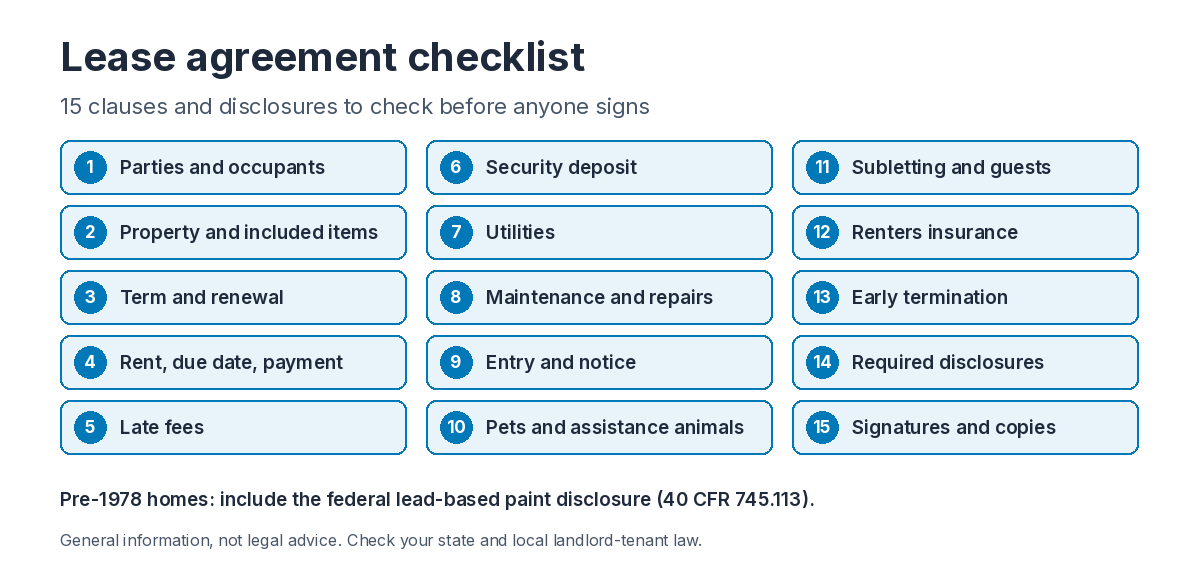
Every residential lease should cover the 15 items below. Use the third column to spot where state or local law may set limits.
| Clause | What it covers | Watch out for |
|---|---|---|
| 1. Parties and occupants | Every adult tenant and every person allowed to live there | Have each adult tenant sign |
| 2. Property and included items | Address, unit number, parking, storage, appliances | List what’s included so there’s no debate at move-out |
| 3. Term and renewal | Start and end dates, fixed term or month to month, renewal steps | Check your state’s notice rules for ending a tenancy |
| 4. Rent, due date and payment method | Amount, due date, where and how to pay | Say what happens if a payment is returned |
| 5. Late fees | When a fee applies and how much | Some states cap late fees (see New York below) |
| 6. Security deposit | Amount, where it’s held, return terms (security deposit laws) | Check your state’s cap and return deadline |
| 7. Utilities | Which utilities each party pays and sets up | Spell out shared or submetered utilities |
| 8. Maintenance and repairs | Who handles which repairs and how to request them | Don’t try to shift repair duties your state assigns to you |
| 9. Entry and notice | When and how you may enter the unit | Check your state’s notice rules for entry |
| 10. Pets and assistance animals | Pet rules, fees and limits (pet policy for rental property) | Handle assistance animal requests separately from pets |
| 11. Subletting and guests | Whether subletting is allowed and how long guests can stay | Check state and local rules on subletting |
| 12. Renters insurance | Whether the tenant must carry a policy, and minimum coverage | State rules vary (see Virginia below) |
| 13. Early termination | How a tenant can end the lease early (how to break a lease) | Check your state’s rules on early exit |
| 14. Required disclosures | Federal lead-based paint disclosure, plus any state or local disclosures | Include every disclosure that applies |
| 15. Signatures and copies | Signatures and dates for all parties, and a copy for each tenant | Keep signed copies with your records |
What disclosures does federal law require in a lease?
For most housing built before 1978, federal law requires a lead-based paint disclosure in the lease or as an attachment. 40 CFR 745.113(b) lists what it must contain.
- A Lead Warning Statement. The required text in 40 CFR 745.113(b)(1) begins: “Housing built before 1978 may contain lead-based paint.” Copy the full statement from the rule word for word.
- Your disclosure. Under 40 CFR 745.113(b)(2), you state any known lead-based paint or hazards in the home, or that you have no knowledge of any.
- A list of records. 40 CFR 745.113(b)(3) requires a list of any lead reports you’ve given the tenant, or a statement that none are available.
- The tenant’s acknowledgment. Under 40 CFR 745.113(b)(4), the tenant confirms receiving the information and the federal lead hazard pamphlet.
- Signatures and dates. 40 CFR 745.113(b)(6) requires signatures from the lessor, any agents and the tenants.
The rule doesn’t cover every older home. Under 40 CFR 745.103, housing for the elderly or persons with disabilities and 0-bedroom units are excluded. That exclusion doesn’t apply if a child under 6 lives or is expected to live there. 40 CFR 745.101 also exempts short-term leases of 100 days or less with no renewal or extension.
Keep the paperwork. 40 CFR 745.113(c) requires lessors to keep a copy of the completed disclosure for at least 3 years from the start of the lease.
Which lease terms do state laws limit?
State laws often limit late fees, deposits, insurance costs and other terms. Check your state’s landlord-tenant law before you finalize a lease. Here are three verified examples.
Late fees in New York. N.Y. Real Prop. Law 238-a(2) bars a late fee unless rent hasn’t been paid “within five days of the date it was due.” The same section says the fee “shall not exceed fifty dollars or five percent of the monthly rent, whichever is less.”
Renters insurance in Virginia. Va. Code 55.1-1206(B) lets a landlord require renter’s insurance as a condition of tenancy if the lease specifies it. The same section requires the landlord to notify the tenant in writing of the right to get a separate policy. Under Va. Code 55.1-1206(C), if premiums are paid to the landlord before the tenancy starts, deposits and premiums together can’t exceed two months’ rent.
Rent reporting in Maryland. The Maryland DHCD says housing providers must offer tenants the option to have positive rent payments reported to consumer reporting agencies, starting with new leases on October 1, 2026. Check the law for details. Our guide to whether paying rent builds credit explains how rent reporting works.
What lease clauses should landlords avoid?
Avoid clauses that waive tenants’ legal rights or treat people differently because of a protected characteristic. These can be unenforceable or illegal.
The Fair Housing Act, at 42 U.S.C. 3604(b), bars discrimination in the terms, conditions or privileges of a rental because of race, color, religion, sex, familial status or national origin. That means one lease for everyone, not stricter terms for families with children. Our guide to questions landlords can’t ask covers the same rules at the application stage.
Clauses where tenants give up legal rights, such as waiving repair duties or notice before entry, may not be enforceable. Rules differ by state, so check your state’s landlord-tenant law before you rely on any waiver.
Also avoid vague terms. “Reasonable cleaning fee” invites a dispute; a clear move-out standard doesn’t.
How does screening connect to the lease?
The lease works best when the tenant who signs it already met written screening criteria that you apply to everyone. Settle your criteria before you advertise, then sign the lease only after screening.
Our guide to tenant screening criteria shows how to write a fair policy. Our rental application form guide covers what to collect before the lease stage.
Apartment One is an online platform where renters complete a verified background and credit screening once, then get matched to rental properties they qualify for, while landlords list properties for free and receive pre-screened applicants. The Tenant Fit Index (TFI) is Apartment One’s 0-100 score matching a renter to a property based on credit, income-to-rent ratio, eviction history, criminal history, and lifestyle preferences. The TFI is a tool used alongside your written criteria, not a ranking or a decision-maker.
Apartment One is FCRA-compliant and follows GLBA and CCPA data handling. Data is encrypted, and payments are processed through Stripe. As a Property Partner, you list free and make your own decision on every applicant.
Before you sign, start with a qualified applicant. List your rental free on Apartment One and review pre-screened applicants against your written criteria.
Frequently asked questions
Is a month-to-month agreement a lease?
Yes. A month-to-month agreement is a rental agreement that renews each month until someone gives notice. It should cover the same core terms as a fixed-term lease. Our guide to month-to-month rentals explains how they work.
Can I use a free online lease template?
You can, but check it against your state’s law first. Then add any required disclosures, such as the lead-based paint disclosure in 40 CFR 745.113 for most pre-1978 homes. Generic forms may not reflect your state’s limits on late fees or deposits.
Do both parties need to sign the lease?
Yes, every adult tenant and the landlord should sign. For pre-1978 housing, 40 CFR 745.113(b)(6) requires signatures and dates from the lessor, any agents and the tenants on the lead disclosure.
Can I change the lease mid-term?
Treat the signed lease as fixed for its term unless the tenant agrees to a change. Put any agreed change in a signed addendum, give the tenant a copy, and check your state’s rules.
Should I have a lawyer review my lease?
It’s a good idea, especially the first time you use a lease or when laws change. A local attorney can confirm your clauses and disclosures match your state and city rules.
5 Responses