

To read a lease before you sign, do not sign the first time you see it. Ask for time to review every page, including addenda, and check rent and fees, the term and early-exit terms, the deposit and the unit’s condition, repairs, entry, guests and pets. Get every promise in writing before you sign.
General information, not legal advice. Lease rules, required disclosures, deposit caps, and early-termination rights vary by state, city, and the contract in front of you. Read the full document, including addenda, and talk to a local attorney or legal-aid office if a clause is unclear.
Why should you read the entire lease before you sign it?
Because a lease is a legally binding contract, and its terms vary by state, locality, property type and rental.
Fannie Mae’s Understanding Your Lease guide says you will sign a legally binding lease agreement and that it is important to understand the terms and conditions before you sign, adding that requirements can vary based on state or locality, property type and the specifics of the rental. Freddie Mac’s guide to understanding your lease also calls a lease a legally binding contract and says ending one early can bring financial and legal consequences.
Freddie Mac adds that there may be room to negotiate certain terms with the landlord before you sign. If this is your first rental, see how to rent your first apartment.
What rent, fees, and payment terms should you check?
Check how much you pay, when it is due, how to pay, any grace period and late fees, and every extra fee listed in the lease.
Fannie Mae’s Understanding Your Lease guide says the lease should show how much you will pay, when payment is due and how to pay it, and should explain any grace periods and late fees. Fannie Mae lists fees to review, including move-in fees, certain utility payments, pet fees, parking fees, amenity fees, key replacement fees and added charges for paying rent by credit card or other methods. Its tip: ask whether any one-time fees are refundable.
Fairfax County, Virginia’s Lease Checklist also says to check which utilities each party pays and whether roommates are jointly and severally liable for the rent. For more on fees, see apartment junk fees and rental application fees.
How long does the lease last, and what happens if you leave early?
Check the start and end dates, what happens at the end of the term, and the early-termination clause, which varies by lease and state.
Freddie Mac’s guide to understanding your lease says a month-to-month lease gives more flexibility because you can give short notice when you are ready to move, but monthly rent might rise more often. A year-long lease protects you from rent increases for the year but gives less flexibility if you need to move early. See month-to-month rentals for more.
Fannie Mae’s Understanding Your Lease guide says typical early-termination policies require a payment of 1 to 2 months’ rent and 30 to 60 days’ notice, and that in some situations subletting may help you avoid an early-termination fee. That describes typical policies, not a legal requirement; your lease and state law control. Fannie Mae also notes renters may be able to end leases for legal reasons under federal requirements like the Servicemembers Civil Relief Act. For your options, see how to break a lease.
What should you check about the security deposit and the unit’s condition?
Check the deposit amount and refund conditions, and do a walk-through so existing damage is written down before you move in.
Fannie Mae’s Understanding Your Lease guide describes the security deposit as refundable and paid to cover potential damage beyond normal wear and tear, and suggests researching local rules for collecting and returning deposits. Freddie Mac’s guide to understanding your lease says a deposit is typically equal to one or two months’ rent; that is a description of common practice, not a legal cap.
Virginia example (state-specific): Fairfax County, Virginia’s Lease Checklist says to review how the deposit will be held, return conditions and whether interest is payable, and notes that in Virginia the security deposit can be no more than two months’ rent. That cap is a Virginia rule, not a U.S. rule.
Freddie Mac recommends a walk-through inspection before you sign, with the landlord documenting any damage or wear and tear in an inspection report, so you can seek your deposit back later. Use our move-in inspection checklist, and see security deposit laws and holding deposits.
What repair, entry, guest, pet, and insurance clauses matter?
Check who handles repairs and how to request them, the landlord’s entry rules, occupancy limits, pet and house rules, and whether renter’s insurance is required.
Fannie Mae’s Understanding Your Lease guide says to check what maintenance services are provided, how to request maintenance (for example in person or through an online portal), and what counts as emergency maintenance, such as flooding or lack of heat or air conditioning. Fannie Mae also says to review property rules for common areas and limits on things like pets, smoking or noise.
Freddie Mac’s guide to understanding your lease says leases should include the number of people who can live in the unit and expectations for noise. Fairfax County, Virginia’s Lease Checklist lists access and entry rules for repairs, inspections and emergencies; whether subleasing, assignment or short-term lodging is allowed; pet rules, noting that the Fair Housing Act and the Americans with Disabilities Act have provisions for service animals; and renter’s insurance, which the page says Virginia landlords must give notice about. Those Virginia items are state-specific.
Related guides: can a landlord enter without notice, pet policies and can a landlord require renters insurance.
What if a promise is not written in the lease?
Get it added in writing before you sign. A verbal promise that is not in the document is difficult to rely on later.
Freddie Mac’s guide to understanding your lease says to make sure anything you negotiate is captured in writing and signed by both parties, and that all terms you discussed are included before you sign. Fairfax County, Virginia’s Lease Checklist says any changes or additions should be in writing and initialed by both parties. If a deal looks wrong or you are pushed to pay before seeing a lease, see rental scams.
What is a quick checklist for reading a lease?
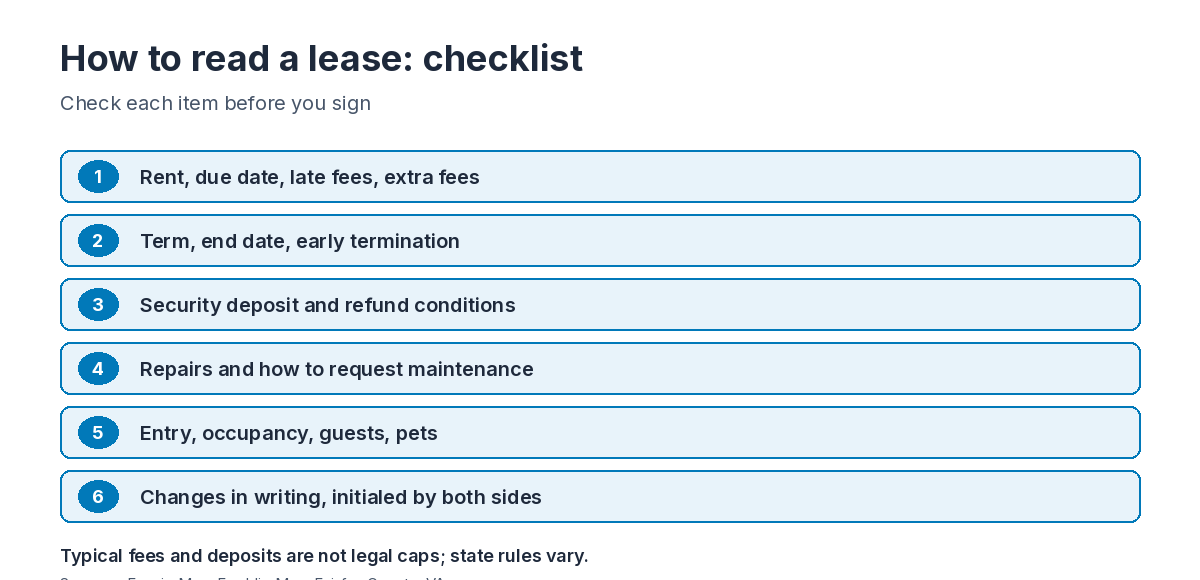
Use this list as you read each page. It draws on the Fannie Mae, Freddie Mac and Fairfax County items above.
- Rent amount, due date, how to pay, grace period and late fees.
- Every extra fee, and which are refundable.
- Start and end dates, and what happens at the end.
- Early-termination and subletting terms.
- Deposit amount and refund conditions.
- Who pays which utilities.
- Repair duties and how to request maintenance.
- Entry and access rules.
- Occupancy, guest, pet, smoking and noise rules.
- Renter’s insurance, if required.
- How notices must be delivered.
- Signatures, with handwritten changes initialed by both sides.
Landlords use a similar list to build the lease; see our lease agreement checklist.
How does Apartment One fit in for renters?
Apartment One lets you screen once and share one report, so you can spend your time on leases for rentals you match with. Learn more about rental tenant screening.
Apartment One is an online platform where renters complete a verified background and credit screening once, then get matched to rental properties they qualify for, while landlords list properties for free and receive pre-screened applicants.
Screening covers credit (FICO 9 from Experian), eviction and criminal records. Quick Screen is $35 one-time for a screening report only, and Tenant Plus is $60 one-time for screening plus access to matched property listings. Pricing can vary by state.
The Tenant Fit Index (TFI) is Apartment One’s 0-100 score matching a renter to a property based on credit, income-to-rent ratio, eviction history, criminal history, and lifestyle preferences. The TFI is a tool used alongside written criteria, not a ranking or a decision-maker.
Apartment One is FCRA-compliant and follows GLBA and CCPA data handling. Data is encrypted, and payments are processed through Stripe.
Screen once, then apply with a shareable report.
Frequently asked questions
Can I negotiate a lease before I sign?
Freddie Mac says there may be room to negotiate certain terms, and that anything you negotiate should be in writing and signed by both parties.
Are early-termination fees always one or two months’ rent?
No. That is Fannie Mae’s description of typical policies, not a legal rule. Your lease and state law control.
Is a two-month security deposit legal everywhere?
Not necessarily. Freddie Mac says deposits are typically one or two months’ rent, and Fairfax County says Virginia caps deposits at two months’ rent. Check your state’s rule.
Should I do a walk-through before signing?
Yes. Freddie Mac recommends a walk-through before you sign, with damage documented in an inspection report.
Does reading the lease replace asking a lawyer about an unusual clause?
No. If a clause is unclear, talk to a local attorney or legal-aid office before you sign.
3 Responses